cloud_dev, Author at All Cloud Hub - Page 4 of 5

Transfer Limits & Expected Times

Bandwidth limits in All Cloud Hub

All Cloud Hub is designed to keep cloud-to-cloud transfers simple, predictable, and fast. We do not artificially slow down transfers, but each plan includes a monthly bandwidth allowance to ensure fair usage and stable performance for all users.

Bandwidth limits by plan

All Cloud Hub includes a monthly transfer bandwidth limit depending on your plan. The Free plan allows up to 5GB of transfer bandwidth per month, while the Power User plan includes 100GB of transfer bandwidth per month. Bandwidth is counted when files are transferred between connected cloud storage accounts using All Cloud Hub.

These limits help keep the service reliable without reducing transfer speed.

No speed throttling

All Cloud Hub does not throttle transfer speed. Transfers do not pass through All Cloud Hub servers, which means the speed of a transfer depends mostly on the cloud storage providers involved and your network connection.

In many cases, the transfer rate is limited by the provider’s API limits rather than by All Cloud Hub itself.

What affects transfer time

The time required for a transfer can vary depending on several factors. Larger files naturally take longer to move, and transfers that contain many small files may also take more time to complete. In addition, cloud provider rate limits and current network conditions can affect how quickly a transfer finishes.

Because of these external factors, transfer duration may differ even for files of similar size.

Plan limits

Each plan controls two things: how much bandwidth you can use per month, and how many cloud accounts you can connect.

The Free plan supports up to three connected cloud accounts, while the Power User plan allows unlimited connected accounts. The main difference between the plans is the available bandwidth, with higher limits provided for users who transfer files more frequently or work with larger storage setups.

Tip

For large transfers, it is recommended to keep the browser tab open until the transfer starts successfully, especially when moving large folders or many files at once.

Summary

All Cloud Hub does not slow down transfers, but each plan includes a monthly bandwidth allowance. Transfer speed and completion time depend mainly on the cloud storage providers, file size, number of files, and network conditions rather than on All Cloud Hub itself.

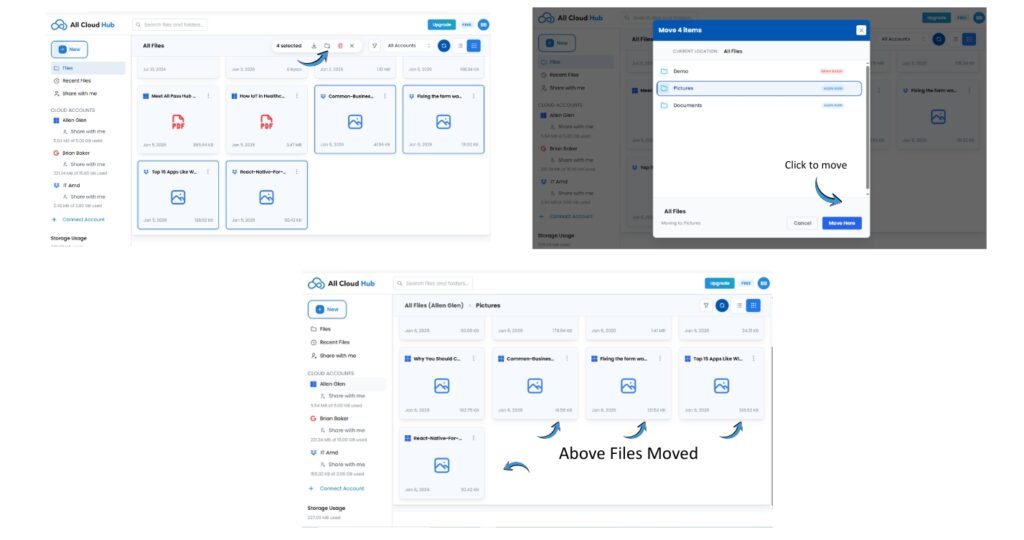
Next: Troubleshooting Failed Transfers.

What Happens During a Transfer

Understanding what happens during a transfer helps set clear expectations and builds confidence.

How Transfers Work

Transfers happen directly between your browser and the connected cloud storage services.

All Cloud Hub does not permanently store your files. Only the required file metadata and transfer state are handled temporarily over a secure connection to track progress and status.

Transfer Flow

  1. You initiate a transfer in FilesVerse
  2. The source cloud transfers files to the destination cloud through a secure, browser-mediated connection
  3. Progress is tracked and visible in the Transfers section

Transfers happen in real time.

Source Cloud → Destination Cloud

Multiple Transfers

If multiple transfers are started, they are queued.

Transfer order and progress are maintained using temporary task metadata, which is cleared once the transfer completes.

If You Open Another Tab

Opening another tab or starting another transfer does not cancel existing transfers. New transfers are added to the queue.

In Summary

Transfers in All Cloud Hub are direct, real-time, and transparent, with clear visibility into progress and status, without storing your files.

Next: Transfer Limits and Expected Times.

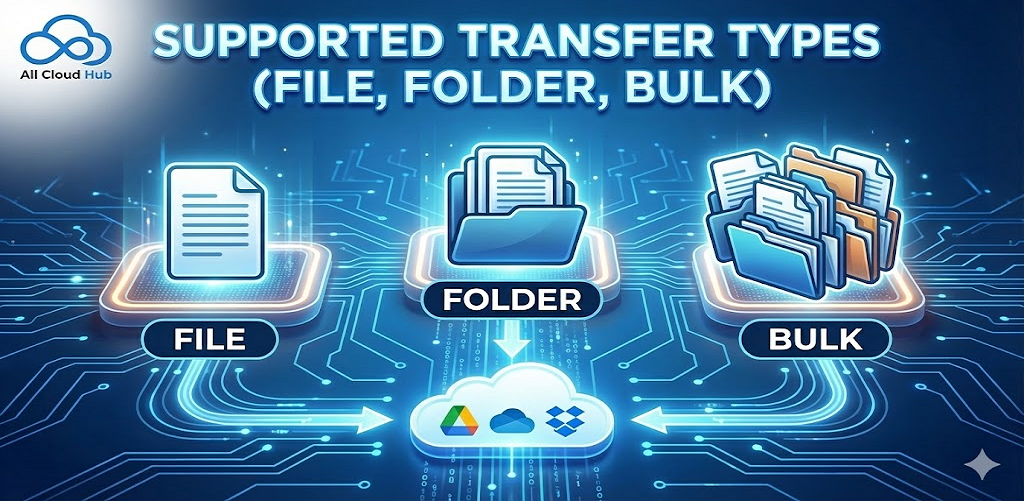
Supported Transfer Types (File, Folder, Bulk)

All Cloud Hub supports multiple transfer types so you can move files in the way that best fits your workflow.

Individual File Transfers

You can transfer individual files between cloud storage accounts.

This is useful for documents, images, or single items that need to be shared or relocated.

Folder Transfers

You can transfer entire folders, including their contents and structure.

Subfolders and files inside the selected folder are transferred together.

Bulk Transfers

You can select multiple files and folders at the same time and transfer them in one action.

This is helpful when moving groups of files or reorganizing content across clouds.

Note

Bulk transfers follow the same copy or move rules as single file transfers.

In Summary

All Cloud Hub supports file, folder, and bulk transfers, giving you flexibility to move content across cloud storage accounts efficiently.

Next: What Happens During a Transfer.

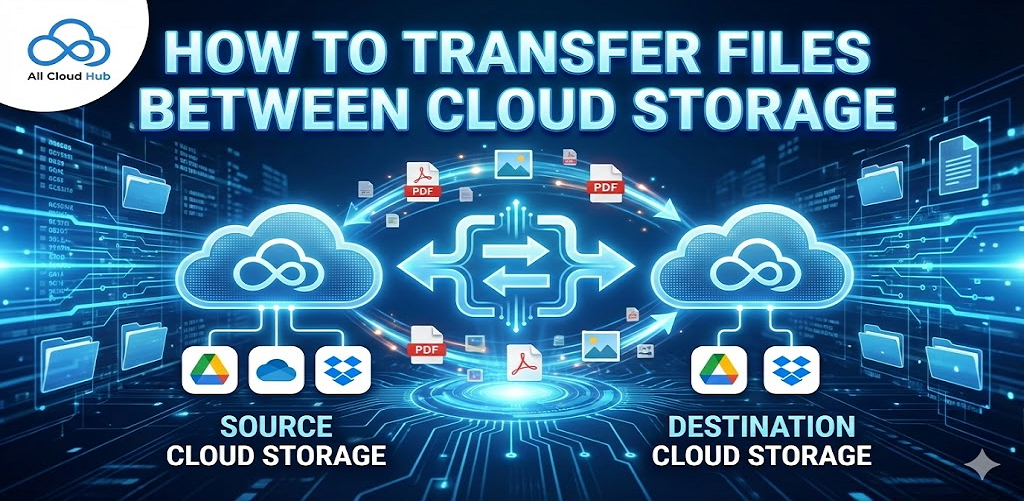
How to Transfer Files Between Cloud Storage

All Cloud Hub allows you to transfer files and folders directly between connected cloud storage accounts.

Transfers happen from one cloud to another without downloading files to your device and without routing files through All Cloud Hub servers.

Starting a Transfer

Transfers are initiated from FilesVerse.

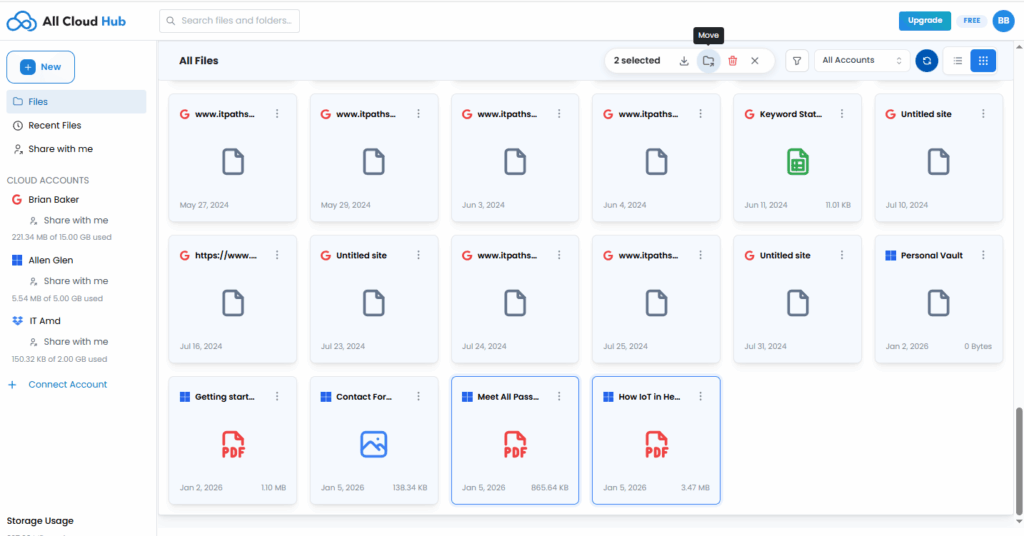
You can start a transfer by selecting one or more files or folders and choosing the transfer action. During the process, you select a destination cloud account where the files should go.

You are also asked to choose whether you want to copy or move the selected items.

File selection with transfer option visible

Choosing Copy or Move

  • Copy creates a new copy of the file in the destination cloud
  • Move transfers the file completely to the destination cloud

Your choice determines what happens to the original file.

Note

Copy keeps the original file intact. Move removes it from the source cloud after the transfer completes.

Completing the Transfer

Once confirmed, the transfer starts immediately.

You can continue using FilesVerse while the transfer is in progress. Transfer activity can be monitored from the Transfers section.

In Summary

Cloud-to-cloud transfers in All Cloud Hub let you move or copy files directly between cloud storage accounts without local downloads or manual re-uploads.

Next: Supported Transfer Types.

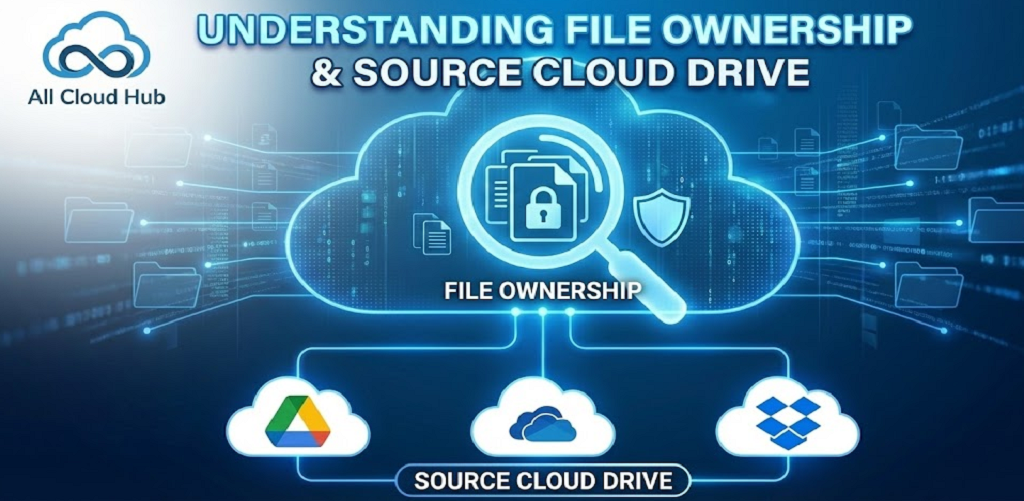
Understanding File Ownership & Source Cloud Drive

When files from multiple cloud storage accounts appear together in FilesVerse, it is important to understand where each file comes from and who owns it.

All Cloud Hub is designed to make this clear while keeping your files fully under your control.

Files Always Belong to Their Original Cloud

All Cloud Hub does not become the owner of your files.

Every file shown in FilesVerse continues to belong to the cloud storage account where it was originally stored. If a file lives in Google Drive, it remains a Google Drive file. If it lives in OneDrive or Dropbox, it remains part of that service.

All Cloud Hub acts as a management layer that lets you view and work with files across clouds without changing ownership.

Note

Seeing files together in FilesVerse does not merge cloud accounts or storage. Each cloud storage account remains separate.

How Source Cloud Is Shown

FilesVerse displays visual indicators that help you identify the source cloud for each file.

From the dashboard, files include cloud-specific icons or labels that show which cloud storage service they belong to. This makes it easy to recognize the source of a file even when files from different accounts appear side by side.

This source information remains visible whether you are browsing files or viewing search results.

File list showing source cloud indicators on files

What Happens When You Copy Files

When you copy a file from one cloud storage account to another using All Cloud Hub, a new copy of the file is created in the destination cloud.

The original file remains unchanged in the source cloud. Each copy is owned and managed by the cloud storage service where it resides.

This is useful when you want the same file available in more than one cloud account.

Tip

Use Copy when you want to keep the original file in its current location and also have it available elsewhere.

What Happens When You Move Files

When you move a file from one cloud storage account to another, the file is transferred fully to the destination cloud.

After the move is complete, the file no longer exists in the source cloud account. Ownership effectively shifts to the destination cloud storage service.

This action is intentional and happens only when you choose to move a file.

Warning

Moving a file removes it from the source cloud. Use this option only when you no longer need the file to remain in its original location.

Working with Files Across Accounts

Even though files appear together in FilesVerse, actions are always applied to the correct source cloud.

When you rename, organize, copy, or move a file, the action is carried out in the cloud storage account where the file lives. All Cloud Hub does not duplicate or cache files unless you explicitly perform a copy.

This ensures that file ownership and cloud boundaries remain clear and predictable.

Why This Matters

Understanding file ownership helps you avoid accidental data loss and makes it easier to manage files across multiple cloud services with confidence.

By clearly showing the source cloud and respecting ownership at all times, All Cloud Hub lets you work across clouds without uncertainty.

In Summary

Files in All Cloud Hub always belong to their original cloud storage accounts.

FilesVerse shows files together for convenience while clearly indicating their source. Copying creates a new file in another cloud, while moving transfers ownership to the destination cloud. All actions happen only when you choose them.

Searching Files Across All Connected Drives

All Cloud Hub includes a built-in search that helps you find files and folders across your connected cloud storage accounts from one place.

Search is available directly inside FilesVerse, so you can look for files without opening individual cloud apps.

Where to Find Search

The search bar is located at the top of the dashboard and is labeled “Search files and folders”.

It remains visible while you are in the Files view, making it easy to start a search at any time.

Top bar highlighting the search field

What Search Looks Through

When you use the search bar, All Cloud Hub searches across the files and folders that are visible in FilesVerse.

If the All Accounts filter is selected, search includes files from all connected cloud storage accounts. This allows you to search once and see results from multiple cloud providers together.

Note

Search respects the current account filter. If you narrow the view to a specific cloud account, search results reflect that selection.

Search Results in FilesVerse

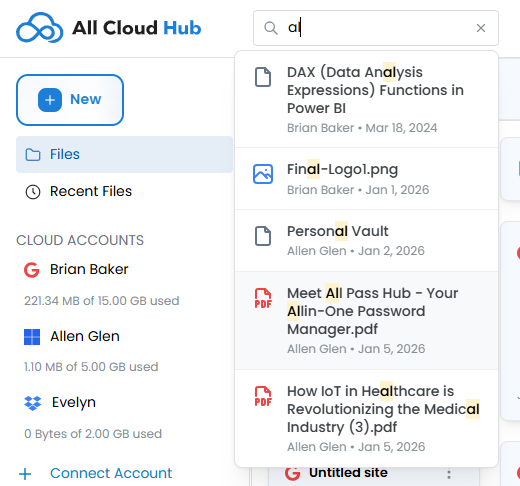
Search results appear directly in the main file area, replacing the standard file list.

Results follow the same visual structure as the Files view:

  • Files and folders appear together
  • Each item includes a visual indicator of its source cloud
  • You can recognize where a file comes from at a glance

This keeps search results consistent with how you normally browse files.

Search results shown in the main file area

Working with Search Results

Files and folders shown in search results can be interacted with directly.

From the search results view, you can select files and take actions such as organizing or transferring them, just as you would from the regular Files view.

You do not need to exit search to work with the files you find.

Clearing or Changing a Search

To change your search, you can update the text in the search bar.

To return to browsing all files, clear the search input. FilesVerse then returns to showing the full file list based on the current account filter.

Why Unified Search Matters

When files are spread across multiple cloud storage accounts, finding the right file often means repeating the same search in different apps.

FilesVerse search removes that repetition by letting you search once and see results from all connected accounts in one place. This saves time and reduces context switching, especially when you are not sure which cloud a file lives in.

In Summary

Search in All Cloud Hub lets you find files and folders across connected cloud storage accounts from a single search bar.

Results appear directly inside FilesVerse, remain clearly labeled by source cloud, and can be acted on immediately. This makes search a natural extension of how you browse and manage files across clouds.

Next:

Understanding File Ownership and Source Cloud: How All Cloud Hub shows where files come from and what happens when files are copied or moved across clouds.

Viewing Files from Multiple Clouds in One Place

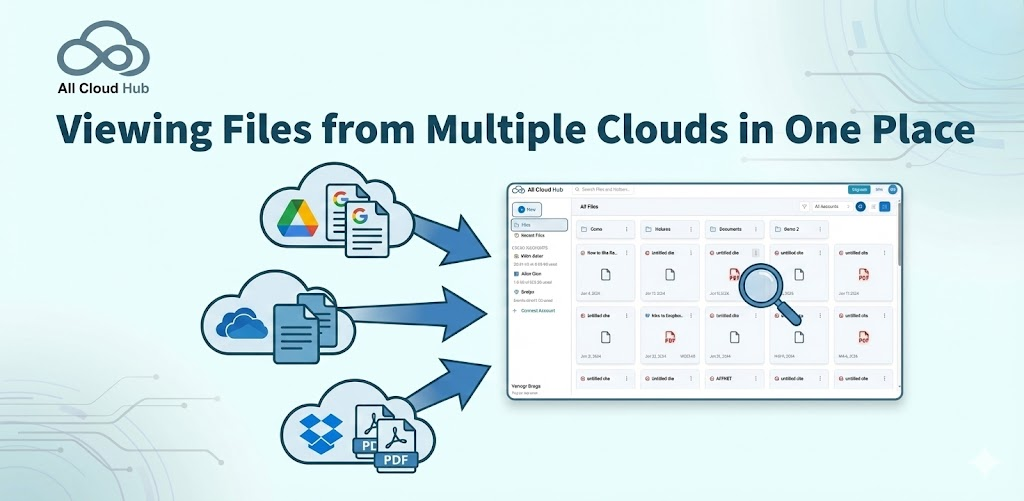
All Cloud Hub allows you to view files and folders from multiple connected cloud storage accounts together inside FilesVerse.

This unified view helps you work across cloud services without switching between individual cloud apps.

The All Files View

When you open FilesVerse, the default view is All Files.

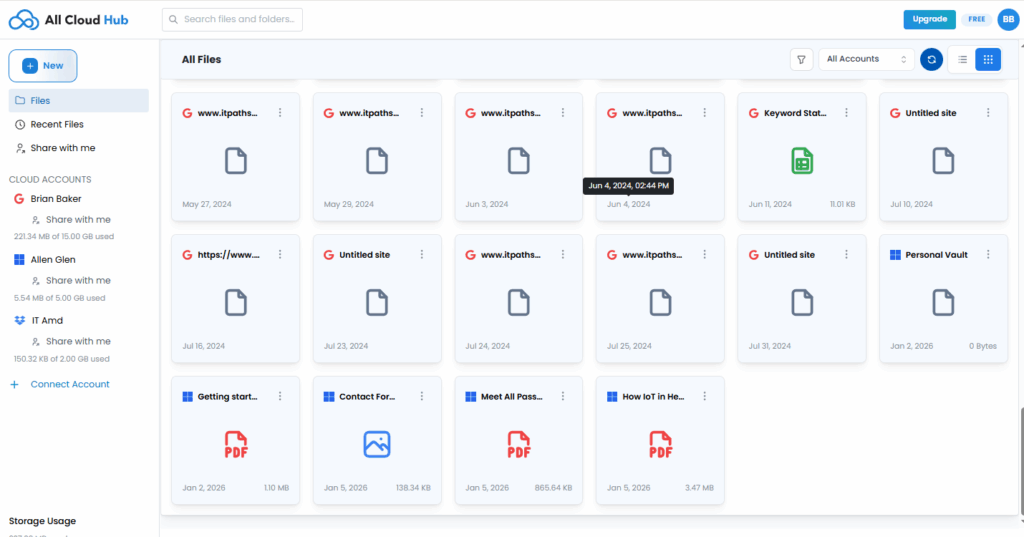
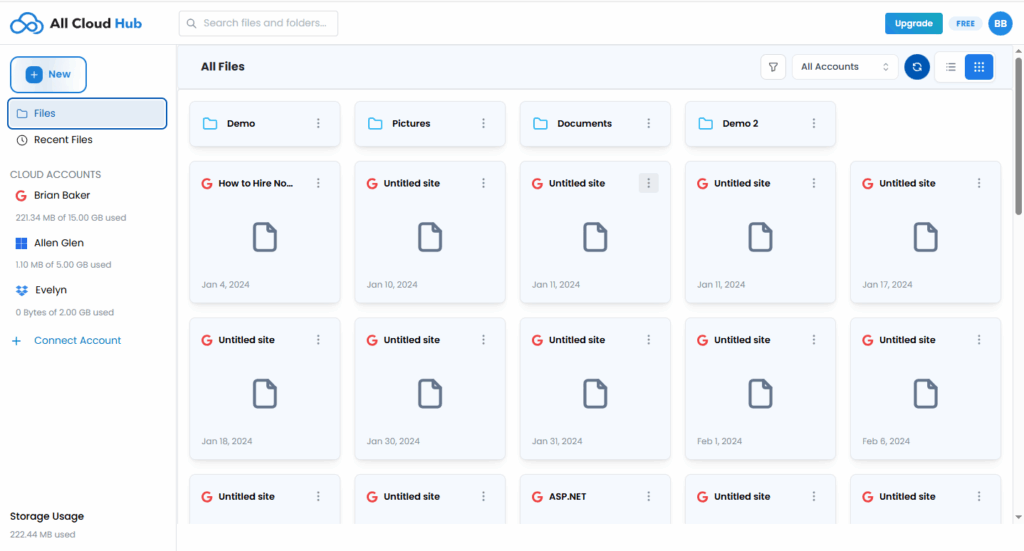
In this view, files and folders from all connected cloud storage accounts appear together in a single workspace. Items are shown in a grid-style layout, making it easy to browse folders and files visually.

Files are not merged or moved. They are only displayed together for easier access.

FilesVerse showing folders and files from multiple cloud accounts together

Note

Seeing files together in FilesVerse does not change where they are stored. Each file continues to live in its original cloud storage account.

Identifying Files from Different Cloud Accounts

FilesVerse shows visual indicators that help you understand where files come from.

From the screenshot, files and folders display cloud-specific icons, such as a Google Drive indicator on files that belong to a Google account. This helps you recognize the source cloud at a glance while browsing mixed content.

This ensures clarity even when files from different cloud accounts appear next to each other.

Using the Account Filter

At the top of the FilesVerse view, there is an All Accounts filter.

This filter allows you to control which cloud accounts are included in the current view. When All Accounts is selected, FilesVerse shows files from every connected cloud storage account. You can use this filter to narrow the view to a specific account when needed.

Account filter set to “All Accounts

Folders and Files in FilesVerse

Folders and files are displayed together in FilesVerse.

Folders appear as clickable items that let you navigate deeper into their structure. Files appear with type-specific icons, such as document or PDF icons, along with basic information like file name and date.

You can interact with both files and folders directly from this view.

Switching Between Files and Recent Files

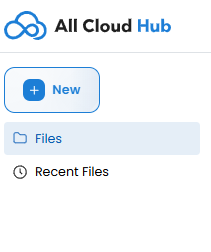
The left navigation includes options such as Files and Recent Files.

  • Files shows the full file and folder structure from connected cloud accounts
  • Recent Files highlights files that were accessed or updated recently

This helps you move quickly between browsing everything and focusing on recently used items.

Left navigation showing Files and Recent Files

Storage Information

The left panel also shows storage usage information for connected cloud accounts.

This gives visibility into how much storage is used within each connected account, without needing to open the individual cloud service.

What This View Does Not Do

The unified view in FilesVerse does not:

  • Move files between cloud accounts automatically
  • Combine storage across cloud providers
  • Change file ownership or permissions

It is a viewing and management layer that sits on top of your existing cloud storage accounts.

In Summary

FilesVerse lets you see files and folders from multiple cloud storage accounts together in one place.

You can browse, identify, and work with files across clouds while always knowing where each file belongs. This makes it easier to manage files spread across different services without switching tools.

Next:

Searching Files Across All Connected Drives: How to find files quickly using FilesVerse Search.

Navigating the All Cloud Hub Dashboard

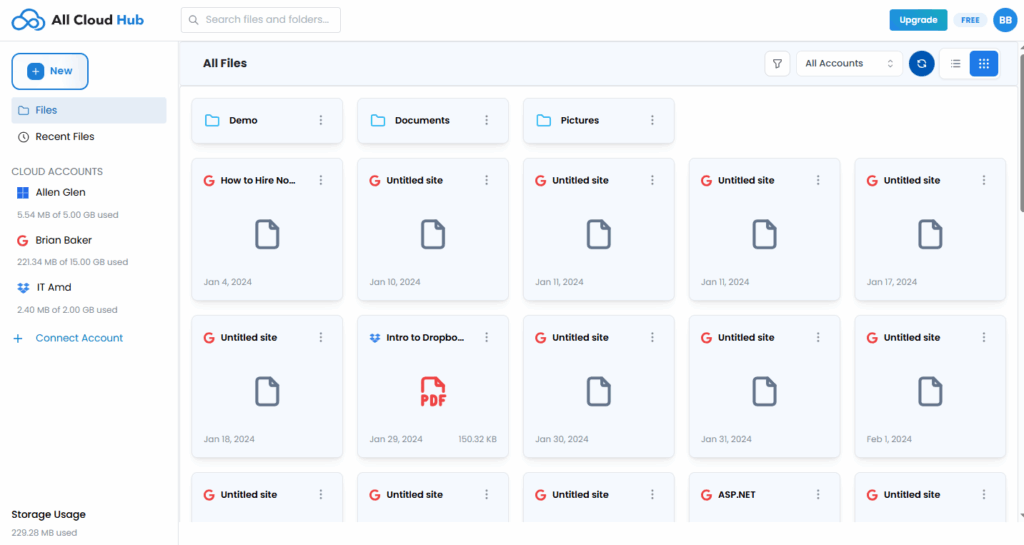
When you sign in to All Cloud Hub, you land directly on the Files view inside FilesVerse.

This screen acts as the main working area of the product. From here, you can browse files, access recent items, view connected cloud accounts, and start managing your files across clouds.

Overall Layout

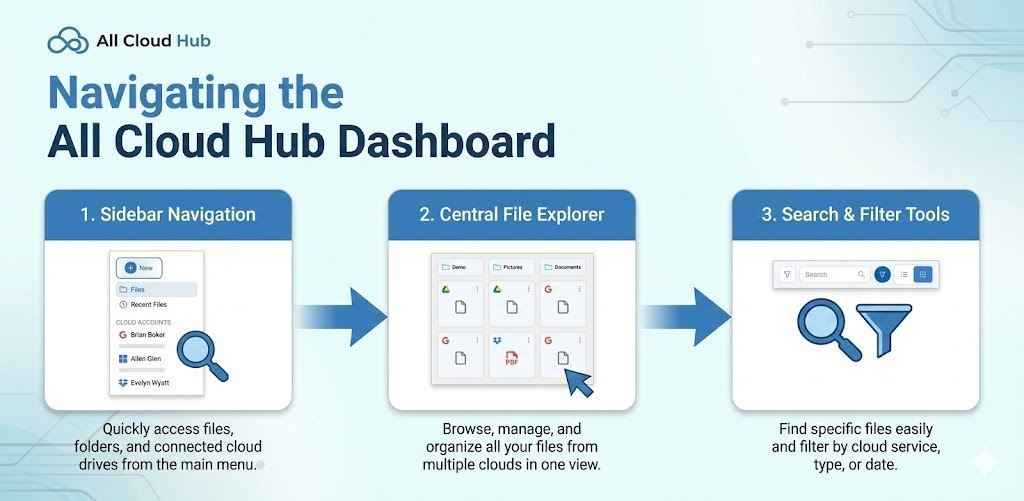
The dashboard is divided into three clear areas:

  • A left sidebar for navigation and cloud account access
  • A top bar for search and view controls
  • The main content area where files and folders are displayed

This layout stays consistent as you move through the product.

Full dashboard highlighting sidebar, top bar, and main file area

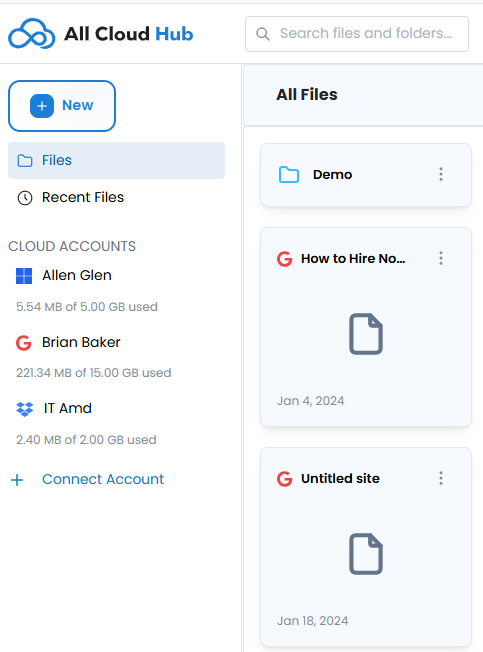
Left Sidebar Navigation

The left sidebar helps you move between key sections without leaving your context.

From the screenshot, the sidebar includes:

  • Files This is the primary view where all files and folders are shown.
  • Recent Files This view helps you quickly access files that were opened or updated recently.

Below this, you will see the Cloud Accounts section.

Cloud Accounts Section

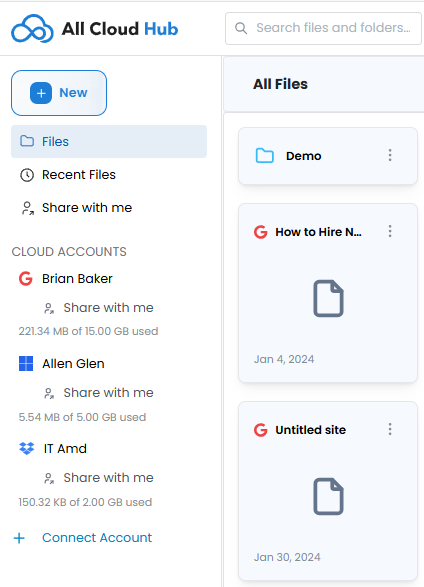
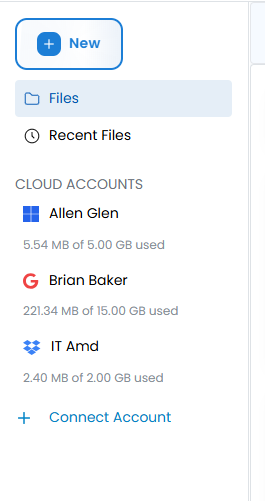
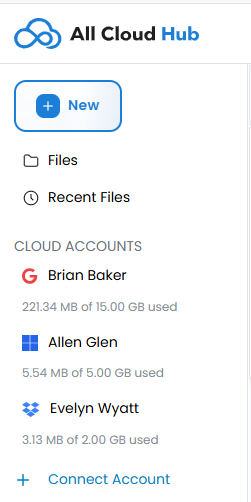
The Cloud Accounts section lists all connected cloud storage accounts.

Each connected account appears with:

  • The account name
  • The cloud provider indicator
  • Storage usage information

You can add a new cloud storage account using Connect Account, which is visible at the bottom of this section.

Cloud Accounts section showing connected accounts and Connect Account

Note

Cloud Accounts are always visible from the dashboard. You do not need to navigate away from FilesVerse to see which accounts are connected.

Top Bar and Search

At the top of the dashboard, there is a search bar labeled “Search files and folders”.

This search is available from the Files view and allows you to look for files and folders across your connected cloud storage accounts.

To the right of the search bar, there are view and filter controls that affect how files are displayed in the main area.

Top bar showing search field and view controls

Main File Area

The main content area displays files and folders from your connected cloud accounts.

By default:

  • The heading shows All Files
  • Items are displayed in a grid-style layout
  • Folders and files appear together
  • Each item includes a visual indicator of its source cloud

You can click into folders to navigate deeper into their structure.

View Controls

The dashboard includes controls that let you adjust how files are displayed.

From the screenshot, users can:

  • Switch between different view layouts
  • Filter files by connected accounts using the All Accounts dropdown

These controls help narrow or broaden what you see without changing where files are stored.

Staying Oriented

The dashboard is designed so that:

  • FilesVerse is always the main working view
  • Cloud account information is always visible
  • Search is always accessible
  • Navigation does not interrupt file browsing

This makes it easy to explore and manage files without losing track of where you are.

In Summary

The All Cloud Hub dashboard brings together navigation, cloud accounts, and files into a single, consistent workspace.

FilesVerse is where you spend most of your time, with connected cloud accounts and search always within reach. The layout helps you move confidently between files, recent activity, and cloud accounts without switching tools.

Next:

Viewing Files from Multiple Clouds in One Place. How FilesVerse shows files from different cloud storage accounts together while keeping them clearly identifiable.

How to Disconnect a Cloud Account Safely

Disconnecting a cloud account from All Cloud Hub removes it from FilesVerse, but it does not affect your actual files.

This guide explains how to disconnect an account, what happens immediately, and what does not happen when you do so.

Where to Disconnect a Cloud Account

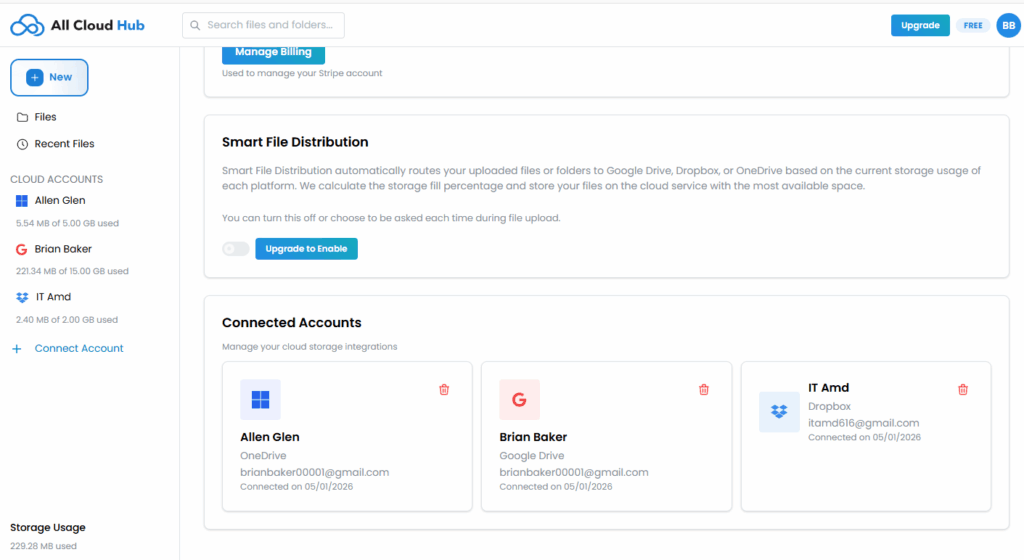
Cloud accounts are managed from the Cloud Accounts section in the All Cloud Hub dashboard.

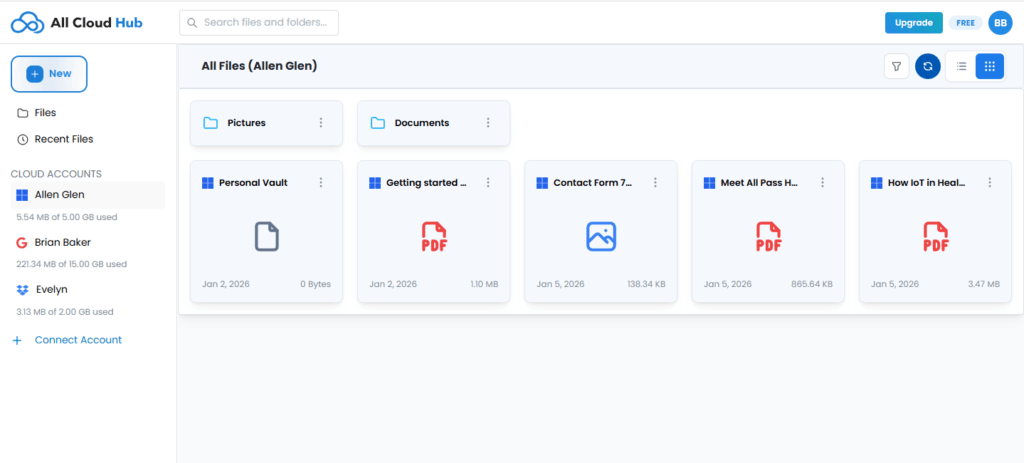
Each connected account appears in the list along with its provider icon and account alias. A Delete or disconnect option is available for each account.

Cloud Accounts list showing the Delete option for a connected account

Disconnecting an Account

To disconnect a cloud account:

  1. Go to the Cloud Accounts section
  2. Locate the account you want to disconnect
  3. Click the Delete option
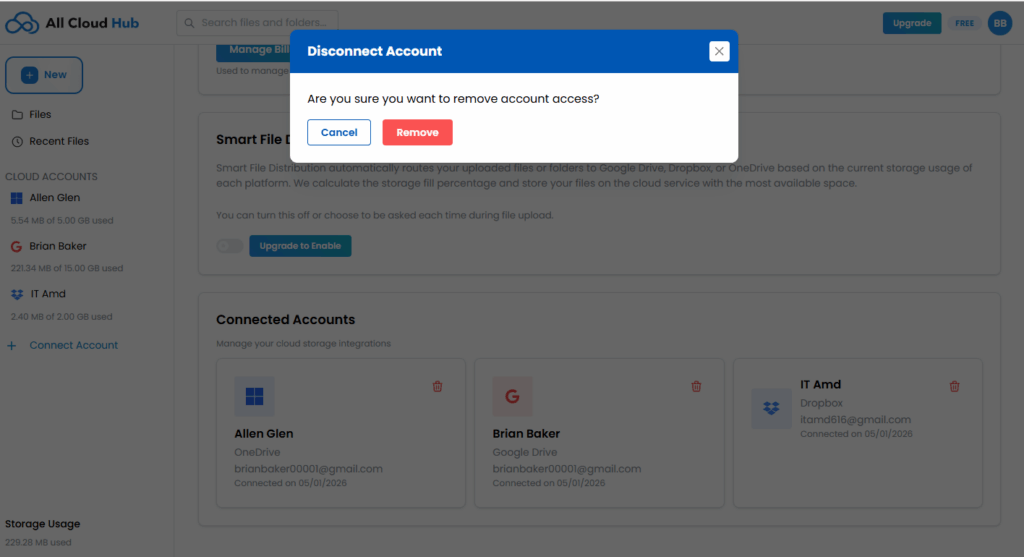
  4. Confirm the action in the confirmation dialog

A confirmation message is shown before the account is disconnected.

Confirmation dialog shown before disconnecting a cloud account

Warning

Disconnecting an account removes it immediately from All Cloud Hub. Make sure you no longer need access to its files in FilesVerse before confirming.

What Happens After You Disconnect

Once the account is disconnected:

  • Files from that account disappear immediately from FilesVerse
  • All Cloud Hub loses access to the cloud account
  • Transfers or actions related to that account stop

This happens right away after confirmation.

What Does Not Happen

Disconnecting a cloud account does not:

  • Delete any files from the cloud provider
  • Modify files or folders in the cloud account
  • Affect other connected cloud accounts

Your files remain exactly as they were in Google Drive, OneDrive, or Dropbox.

Note

Disconnecting an account only affects visibility and access inside All Cloud Hub. It does not change anything inside the cloud storage service itself.
Reconnecting an Account Later

You can reconnect the same cloud account at any time.

To reconnect:

  • Click Connect Account
  • Add an account alias
  • Select the cloud provider
  • Complete the authorization flow again

There is no limit on how many times an account can be connected or disconnected, as long as you stay within your plan’s total account limit.

If Something Goes Wrong

If an account was disconnected accidentally, simply reconnect it using Connect Account.

If a connection attempt fails:

  • The account is not added
  • An error message is shown
  • You can retry the process immediately

In Summary

Disconnecting a cloud account from All Cloud Hub is safe and reversible.

Files disappear from FilesVerse, but they remain untouched in the cloud provider. Other connected accounts continue to work as expected, and you can reconnect the same account whenever you need.

What Permissions All Cloud Hub Requests (& Why)

When you connect a cloud storage account to All Cloud Hub, you are asked to grant certain permissions.

This page explains what permissions are requested, why they are needed, and what All Cloud Hub does and does not do with that access.

Why Permissions Are Required

All Cloud Hub is designed to let you work with your files directly from FilesVerse.

To do this, it needs permission to access your cloud storage account in ways that match the actions you choose to perform, such as viewing files, organizing folders, or transferring files between clouds.

Permissions are not used for background activity or automated changes.

Permissions All Cloud Hub Requests

When you connect a supported cloud storage account, All Cloud Hub requests permission to:

  • View file and folder metadata such as names, paths, and sizes
  • Read file contents so files can be displayed and transferred
  • Create new files and folders when you copy or transfer items
  • Modify existing files and folders when you rename or organize them
  • Delete files only when you explicitly move or delete them

These permissions allow All Cloud Hub to act on your behalf only when you initiate an action.

Note

All Cloud Hub does not perform any file action unless you explicitly request it inside the dashboard.

Provider Permission Screens

Each cloud provider shows its own permission screen during connection.

  • Google Drive, OneDrive, and Dropbox use different wording
  • The intent of the permissions is the same across providers
  • Any visible differences are cosmetic rather than functional

All Cloud Hub documents the connection flow once because the user experience is effectively the same.

What All Cloud Hub Does Not Do

Even with permissions granted, All Cloud Hub does not:

  • Access your files in the background without user action
  • Make automated changes to your files
  • Read or modify files you do not interact with
  • Use your data for any purpose outside file management

All file actions are user-initiated and visible to you.

Permissions and File Actions

Permissions enable specific actions you choose, including:

  • Renaming files and folders
  • Moving or copying files within a cloud account
  • Transferring files between different cloud storage accounts
  • Syncing folders across clouds

If you never perform these actions, All Cloud Hub does not perform them for you.

Revoking Permissions

You can revoke permissions at any time by disconnecting a cloud account from All Cloud Hub.

When a cloud account is disconnected:

  • All Cloud Hub immediately loses access to that account
  • Files from that account disappear from FilesVerse
  • No files are deleted or modified in the cloud provider

You can reconnect the same account later if needed.

Tip

If you are ever unsure about access, disconnecting and reconnecting an account is a safe way to reset permissions.

In Summary

All Cloud Hub requests permissions only to support actions you explicitly choose to perform.

Files remain stored in your cloud storage accounts at all times. All Cloud Hub does not access files in the background, make automated changes, or store file contents.

Permissions exist to give you control, not to take it away.

Next:

How to Disconnect a Cloud Account Safely.

How to Connect Dropbox to All Cloud Hub

This guide explains how to connect a Dropbox account to All Cloud Hub.

Once connected, files and folders from your Dropbox account begin appearing inside FilesVerse, where you can manage them alongside files from other connected cloud storage accounts.

Before You Start

Before connecting Dropbox, make sure:

  • You have a Dropbox account
  • You are signed in to All Cloud Hub
  • You are within your plan’s account limit
    • Free plan allows up to three connected cloud accounts
    • Power User plan allows unlimited connected accounts

Step 1: Open the Connect Account Screen

From the All Cloud Hub dashboard, go to the Cloud Accounts section.

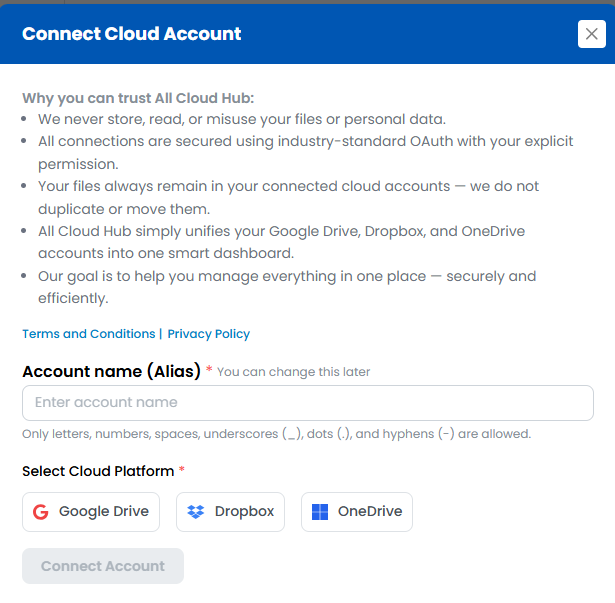
Click Connect Account to open the cloud selection screen.

Connect Account screen showing Google Drive, OneDrive, and Dropbox options

Step 2: Add an Account Alias

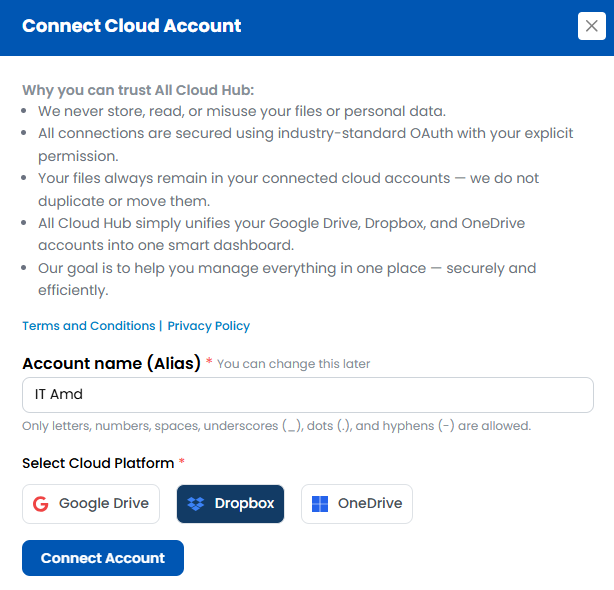
To connect Dropbox, you must first enter an Account Alias.

The Account Alias is a nickname that helps you identify this Dropbox account inside All Cloud Hub. This is useful if you connect more than one Dropbox account.

Examples include:

  • Personal Dropbox
  • Client Dropbox
  • Team Dropbox

After entering the alias, select Dropbox as the cloud platform.

The Connect Account button becomes active once both fields are filled.

Account Alias field with Dropbox selected


Tip

Choose an alias that clearly describes how you use this Dropbox account. The alias appears throughout FilesVerse and Cloud Accounts.

Step 3: Sign In to Dropbox

Click Connect Account.

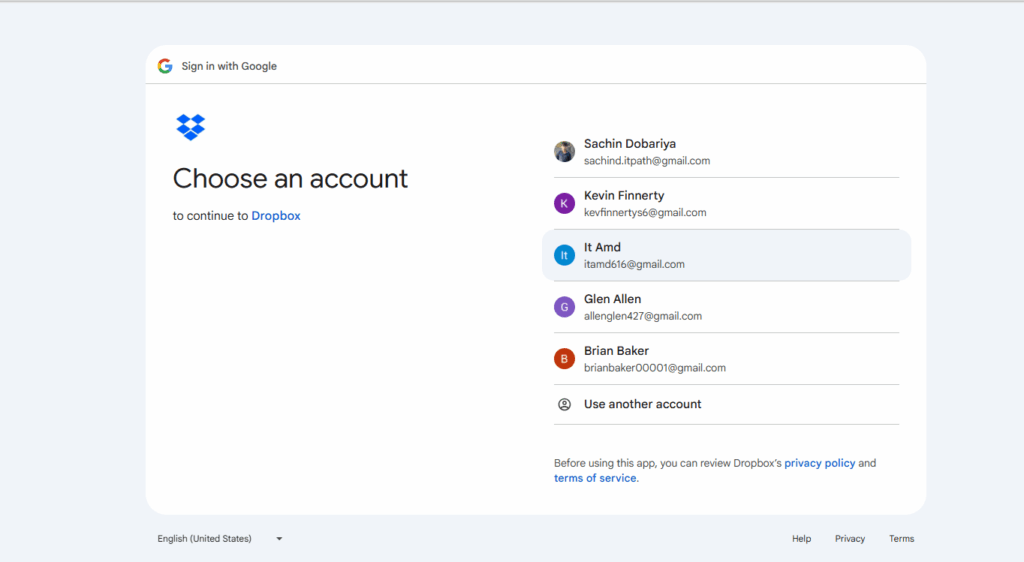
You are redirected to the Dropbox sign-in page. Sign in using the Dropbox account you want to connect.

If you are already signed in to multiple Dropbox accounts, Dropbox will ask you to choose the account to authorize.

Dropbox sign in and authorization screen

Step 4: Grant Permissions

Dropbox will ask you to grant permissions so All Cloud Hub can work with your files.

These permissions allow All Cloud Hub to access required file information and perform actions you choose, similar to other supported cloud providers. They are required so you can:

  • View files and folders
  • Rename and organize files
  • Copy or move files
  • Transfer files between cloud storage accounts
  • Sync folders across clouds

All actions are performed only when you initiate them inside All Cloud Hub.

Note

All Cloud Hub does not access files in the background or make changes without your action. File metadata is handled securely and removed automatically once tasks are completed or the account is disconnected.

Step 5: Return to FilesVerse

After approving the permissions, you are redirected back to FilesVerse.

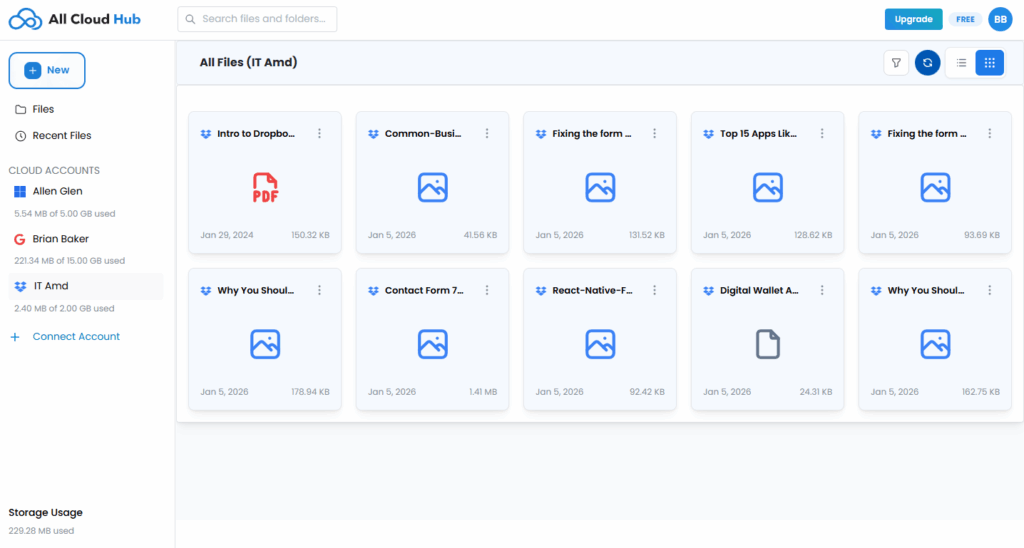
There is no success message. Your Dropbox account is connected automatically, and its files and folders begin appearing in the dashboard.

The connected Dropbox account is listed under Cloud Accounts, identified by:

  • The Dropbox icon
  • The Account Alias you provided
FilesVerse showing files from a newly connected Dropbox account

What Happens Next

Once connected, you can immediately:

  • View Dropbox files alongside files from other cloud accounts
  • Search Dropbox files using FilesVerse search
  • Rename and organize files directly from the dashboard
  • Transfer files between Dropbox and other connected clouds

All files remain stored in your Dropbox account. All Cloud Hub temporarily handles only the required file metadata to display details and perform actions, and does not store file contents.

If the Connection Fails

If the browser is closed during sign-in, or if permission is denied, the connection is not established.

In this case:

  • The Dropbox account is not added
  • You can retry the connection using Connect Account

An error message is shown if the connection fails.

In Summary

Connecting Dropbox to All Cloud Hub requires adding an account alias, selecting Dropbox, and approving access through Dropbox.

Once connected, your Dropbox files appear in FilesVerse automatically and can be managed alongside your other cloud storage accounts.

Next:

What Permissions All Cloud Hub Requests (and Why).

How to Connect OneDrive

This guide explains how to connect a OneDrive account to All Cloud Hub.

After connecting OneDrive, its files and folders begin appearing inside FilesVerse, where you can work with them alongside files from other connected cloud storage accounts.

Before You Start

Before connecting OneDrive, make sure:

  • You have a Microsoft account with access to OneDrive
  • You are signed in to All Cloud Hub
  • You are within your plan’s account limit
    • Free plan allows up to three connected cloud accounts
    • Power User plan allows unlimited connected accounts

Step 1: Open the Connect Account Screen

From the All Cloud Hub dashboard, locate the Cloud Accounts section.

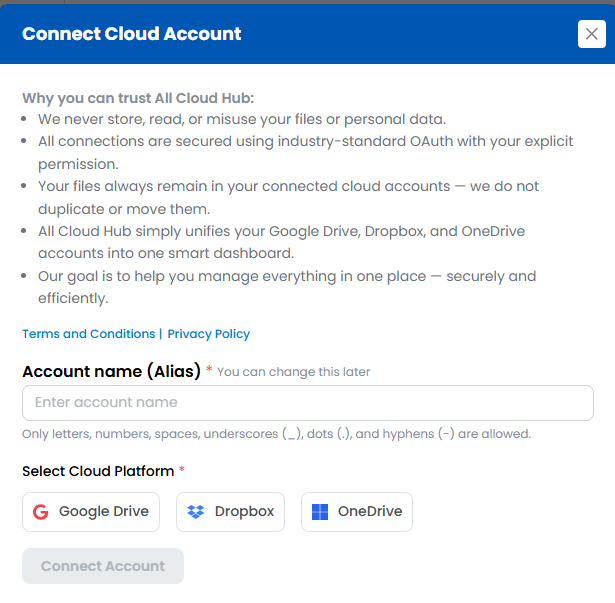
Click Connect Account to open the cloud selection screen.

Connect Account screen showing Google Drive, OneDrive, and Dropbox options

Step 2: Add an Account Alias

To connect OneDrive, you must first enter an Account Alias.

The Account Alias is a short name that helps you identify this OneDrive account inside All Cloud Hub. This is useful if you plan to connect more than one OneDrive account.

Examples include:

  • Personal OneDrive
  • Work OneDrive
  • Client OneDrive

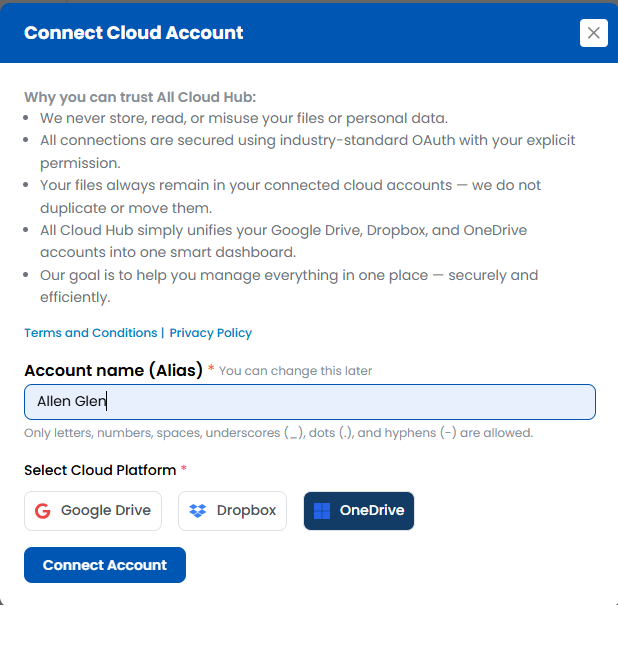
After entering the alias, select OneDrive as the cloud platform.

The Connect Account button becomes active once both fields are filled.

Account Alias field with OneDrive selected

Tip

Choose an alias that clearly reflects how you use this OneDrive account. The alias appears throughout FilesVerse and Cloud Accounts.

Step 3: Sign In to OneDrive

Click Connect Account.

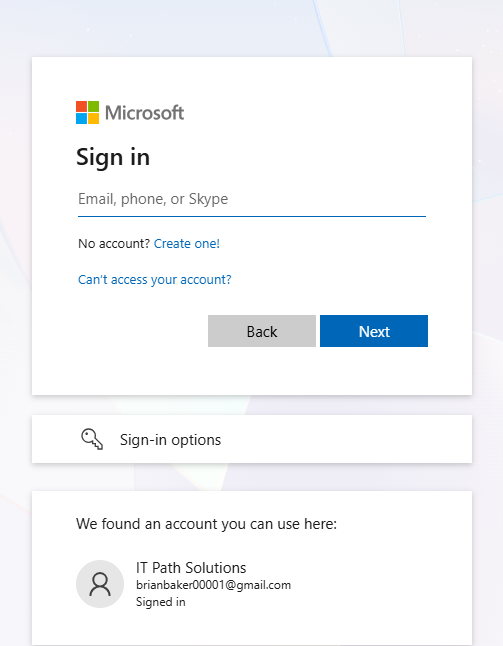
You are redirected to the Microsoft sign-in page. Sign in using the Microsoft account associated with the OneDrive account you want to connect.

If you have access to multiple Microsoft accounts, you will be prompted to choose one.

Microsoft sign-in and account selection screen

Step 4: Grant Permissions

Microsoft will ask you to grant permissions so All Cloud Hub can work with your OneDrive files.

These permissions allow you to:

  • View files and folders
  • Create, rename, and organize files
  • Copy or move files
  • Transfer files between cloud storage accounts
  • Sync folders across clouds

All Cloud Hub uses these permissions only when you perform actions inside the dashboard.

Note

All Cloud Hub does not make changes to your OneDrive files unless you explicitly initiate an action.

Step 5: Return to FilesVerse

After approving the permissions, you are redirected back to FilesVerse.

There is no confirmation message. Your OneDrive account is connected automatically, and its files and folders start appearing in the dashboard.

The connected OneDrive account is listed under Cloud Accounts, identified by:

  • The OneDrive icon
  • The Account Alias you provided
FilesVerse showing files from a newly connected OneDrive account

What Happens Next

Once connected, you can immediately:

  • View OneDrive files alongside files from other cloud accounts
  • Search OneDrive files using FilesVerse search
  • Rename and organize files directly from the dashboard
  • Transfer files between OneDrive and other connected clouds

All files remain stored in your OneDrive account.

If the Connection Fails

If the browser is closed during sign-in, or if permissions are denied, the connection is not completed.

In such cases:

  • The OneDrive account is not added
  • You can retry the process using Connect Account

An error message is shown when the connection fails.

In Summary

Connecting OneDrive to All Cloud Hub involves adding an account alias, selecting OneDrive, and approving access through Microsoft.

Once connected, your OneDrive files appear in FilesVerse automatically and can be managed alongside your other cloud storage accounts.

Next:

How to Connect Dropbox to All Cloud Hub.