manage cloud storage Archives - All Cloud Hub

How to Choose the Right Cloud Storage Capacity for Your Needs

You’re uploading a file when the error appears: storage full. Suddenly you’re locked out of syncing, backups stop running, and you’re scrambling to figure out which cloud account hit its limit.

Cloud storage capacity is the remote server space available for your files, and in 2026, free tiers range from 2GB to 20GB while paid plans scale into the terabytes. This guide covers how to calculate what you actually need, what counts toward your quota, and how to manage storage across multiple clouds without the constant tab-switching.

What is cloud storage capacity

Cloud storage capacity is the amount of remote server space you can use to store your digital files. Instead of saving everything to your computer’s hard drive, you’re renting space on servers owned by companies like Google, Microsoft, or Dropbox (these now serve an estimated 2.3 billion personal cloud users.) In 2026, free tiers typically range from 2GB to 20GB depending on the provider, while paid plans scale from 50GB up to 20TB or more.

The concept is similar to renting a storage unit. You pay for a certain amount of space, and everything you put inside counts toward that limit. The key difference is that cloud storage lives on remote servers, so you can access your files from any device with an internet connection.

How much cloud storage do you need

Most people don’t think about storage limits until they hit one. You try to upload a file, and suddenly you’re staring at an error message. The right amount of capacity depends on what you’re storing and how quickly you add new files.

Personal use and document storage

Text documents, spreadsheets, and PDFs take up very little space. A typical Word document is less than 1MB, which means you could store thousands of them in just a few gigabytes.

If you mainly work with documents and don’t back up photos or videos to the cloud, a free tier for personal use often covers everything you need. Light users can go years without approaching their storage limit.

Photo and video libraries

Photos and videos are where storage fills up fast. A single high-resolution photo from a modern smartphone can be 5MB or more. A one-minute 4K video might take up 400MB.

If you have automatic photo backup turned on, and most people do, you’ll likely fill a free tier within months. This is the most common reason people run out of space without realizing it.

Professional and business files

Design files, video projects, client deliverables, and full system backups require substantially more room. A single Photoshop file can exceed 1GB, and video editors routinely work with files measured in tens of gigabytes.

Professionals managing large or growing file libraries typically find that paid plans pay for themselves in convenience. Running out of space mid-project creates friction you don’t want to deal with.

What counts toward your cloud storage quota

Your quota is the total space allocated to your account. However, not every provider counts items the same way, so understanding what actually uses your space helps you avoid surprises.

Files and documents

Standard uploads like PDFs, Word docs, spreadsheets, and presentations count against your quota on every provider. This part is straightforward: if you upload it, it takes up space.

Emails and attachments

Some providers share storage across services. Google, for example, splits your 15GB free tier across Gmail, Google Drive, and Google Photos. Email attachments sitting in your inbox count against the same quota as your Drive files.

Photos and videos

Media files typically count toward your quota, though some providers offer settings that affect how much space they use. Google Photos previously offered compressed uploads that didn’t count against storage, though that policy changed in 2021.

Shared files and folders

Files you own count against your quota even when you share them with others. On the other hand, files that someone else shares with you typically don’t count against your storage. The owner’s account absorbs that cost.

Trash and deleted items

Deleted files often sit in the trash and continue using your quota until they’re permanently removed. Most providers auto-delete trash after 30 days, but until then, those files still occupy space.

How to calculate your cloud storage requirements

A simple three-step process helps you estimate what you actually need instead of guessing.

1. Audit your current file usage

Start by checking your current storage usage in each cloud account’s settings. Google Drive shows this under “Storage,” Dropbox under “Account settings,” and OneDrive in “Manage storage.”

If you use multiple clouds, you’ll have to check each one separately. Alternatively, a multi-cloud manager can show all your accounts in one view, which saves time if you’re juggling several providers.

2. Estimate future storage growth

Next, consider how your storage will grow. Will you be adding photos monthly? Taking on new client projects? Backing up additional devices? With global data creation on track to reach 230–240 zettabytes in 2026, a reasonable approach is to estimate your growth over the next one to two years and plan accordingly.

Upgrading mid-year is always possible, but planning ahead avoids interruptions.

3. Add buffer space for flexibility

Finally, choose a plan with extra headroom so you don’t hit capacity limits unexpectedly. Running out of space can block syncing, pause automatic backups, and prevent new uploads entirely.

A 20-30% buffer above your estimated usage gives you room to breathe without overpaying.

Cloud storage capacity by provider

Each major provider structures their free and paid tiers differently. Here’s how they compare in 2026:

ProviderFree tierMaximum paid capacityNotable features
Google Drive15GB (shared with Gmail and Photos)30TBStrong collaboration, Google Workspace integration
Dropbox2GB3TB (individual)Reliable syncing, file versioning
OneDrive5GB6TB (with Microsoft 365 Family)Microsoft 365 integration
iCloud5GB12TBBest Apple device integration
pCloud10GB10TB (lifetime plans available)European-based, optional client-side encryption

Google Drive

Google’s 15GB free tier is generous, but remember that it’s shared across Gmail, Drive, and Photos. If your inbox is full of attachments, your Drive space shrinks accordingly – and at that point, migrating files to OneDrive can free up room without deleting anything. Paid plans are available through Google One, scaling up to 30TB.

Dropbox

Dropbox offers one of the smallest free tiers at just 2GB. However, it’s known for reliable syncing and solid file versioning, which lets you recover previous versions of documents.

Microsoft OneDrive

OneDrive includes 5GB free with every Microsoft account. Larger capacity comes bundled with Microsoft 365 subscriptions, making it a natural fit if you already use Word, Excel, or Outlook.

iCloud

Apple’s iCloud starts with 5GB free for every Apple ID. It offers the tightest integration with Apple devices, and paid tiers now scale up to 12TB for users with large photo and video libraries.

pCloud

pCloud stands out by offering lifetime plans as an alternative to monthly subscriptions. It’s European-based and includes optional client-side encryption for users who want extra privacy.

Free vs paid cloud storage plans

Free plans work well for light users or for testing a provider before committing. They typically offer limited capacity, basic features, and standard support.

Paid plans unlock more storage, priority support, advanced sharing controls, and often family sharing options. Many also include additional security features like extended version history.

Some users combine multiple free accounts to get more total space. For example, 15GB from Google plus 5GB from OneDrive plus 2GB from Dropbox adds up to 22GB. This works, but it creates management complexity when your files are scattered across three different dashboards with three different logins.

What happens when your cloud storage is full

When you hit your limit, new uploads and syncs stop working. You won’t be able to add files until you free up space or upgrade your plan.

For providers with shared quotas like Google, a full Drive can also mean Gmail stops receiving attachments. Automatic backups, like phone photo backup, will pause silently in the background without notifying you.

Most providers offer a grace period before restricting access to existing files, but the disruption to your workflow starts immediately. Proper capacity planning prevents this scenario entirely.

How to free up cloud storage space

When you’re running low, a few practical steps can help you reclaim space quickly.

1. Empty your trash across all clouds

Deleted files sit in the trash and continue using your quota. Permanently deleting them is often the fastest way to free up significant space, especially if you’ve been deleting files without emptying the trash for months.

2. Remove duplicate files

Duplicates are common when files sync across devices or get copied between folders. You can check for duplicates manually by sorting files by name, or use a dedicated duplicate-finder tool to speed up the process.

3. Delete large or unused files

Most cloud providers let you sort files by size. Review the largest files first. Old downloads, outdated project versions, and files you no longer reference are often the biggest space hogs.

4. Move files to another cloud

If one cloud is full but another has space, you can transfer files between them. This typically requires downloading to your device and re-uploading, unless you use a cloud-to-cloud transfer tool that moves files directly between providers without routing through your computer.

How to manage storage across multiple clouds

The average organization now uses 3.4 different cloud providers, which means tracking capacity across separate dashboards, different logins, and different interfaces. Over time, this gets tedious.

See your total capacity in one view

A unified dashboard shows storage usage across all connected clouds without logging into each account separately. You can see at a glance which cloud has space and which is running low.

Move files between clouds without downloading

Cloud-to-cloud transfers route files directly between providers. Instead of downloading a 2GB folder to your laptop and re-uploading it elsewhere, the transfer happens server-to-server. This approach is faster and doesn’t eat your bandwidth.

Sync folders to balance storage automatically

Folder sync keeps files updated across clouds, helping distribute the storage load without manual copying. When one cloud fills up, you can shift files to another and keep them in sync going forward.

Tip: All Cloud Hub connects Google Drive, Dropbox, OneDrive, and pCloud in one dashboard. You can search across all clouds at once, drag-and-drop files between providers, and see your total storage without switching tabs. Your files stay in your own accounts, and All Cloud Hub never stores, copies, or caches them. Authentication happens through OAuth 2.0, so your login credentials are never shared. Connect your clouds in under a minute →

FAQs about cloud storage capacity

Is 1TB the same as 100GB?

No. 1TB (terabyte) equals approximately 1,000GB (gigabytes), so 1TB provides about ten times more storage than 100GB.

Does sharing files with others use my storage quota?

Files you own and share count against your quota. Files others share with you typically don’t count against your storage. The owner’s account absorbs that usage.

How long do deleted files stay in cloud storage trash?

Most providers automatically empty the trash after 30 days. Until then, files continue using your quota, so emptying the trash manually frees up space immediately.

Can I combine storage from multiple cloud accounts into one total pool?

Cloud providers don’t merge storage across accounts. However, multi-cloud managers let you view and move files between accounts from a single dashboard, making it easier to use your total available space across providers.

Is Google giving 1TB of free storage?

No. Google provides 15GB free, shared across Gmail, Drive, and Photos. Larger capacities are available through paid Google One plans starting at 100GB.
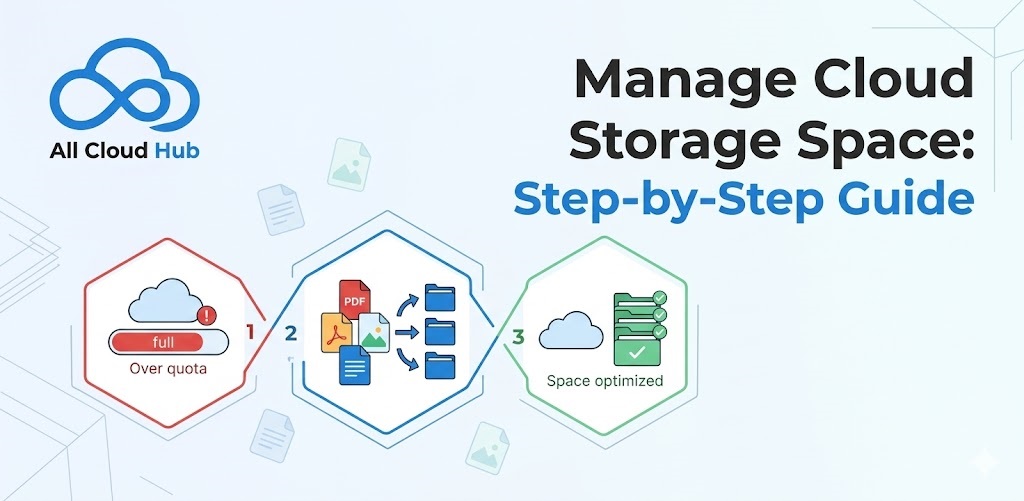
Manage Cloud Storage Space: Step-by-Step Guide

You’re staring at a “storage full” notification, but you haven’t saved anything new in weeks. Meanwhile, your files are scattered across Google Drive, Dropbox, OneDrive, and iCloud, each with its own storage limit and no way to see the full picture.

In 2025, 55% of people use three or more cloud services without a clear strategy for managing any of them. This guide walks you through checking your storage, freeing up space, and organizing files across all your cloud accounts without the usual download-and-reupload hassle.

What is cloud storage and why does it fill up

Cloud storage management, a $29.7 billion consumer industry, involves organizing, securing, and optimizing data stored on remote servers via third-party providers like Google, Microsoft, Apple, and Dropbox. In 2025, most people use at least two or three of these services, often without realizing how quickly space disappears.

Your storage fills up for a few predictable reasons. Automatic photo backups run quietly in the background every time you take a picture. Email attachments accumulate over months and years. Old device backups from phones you traded in years ago sit forgotten. Duplicate files, often created when sync conflicts occur, multiply without any notification.

Once you understand where your space is going, reclaiming it becomes much simpler.

How to check your cloud storage usage

Before deleting anything, you want to know exactly where you stand. Each major cloud provider offers a storage breakdown, though they place it in slightly different locations.

Google Drive

Navigate to drive.google.com/settings/storage to see your usage. One detail that surprises many users: Google shares this storage across Drive, Gmail, and Google Photos. A bloated inbox with years of attachments can eat into your Drive space even if you rarely save files there.

OneDrive

Go to onedrive.com, click Settings, then Storage. This page shows what counts toward your quota. Files shared with you that you’ve added to your own OneDrive also count against your limit.

Dropbox

Access your account at dropbox.com/account and click the Plan tab. You’ll see a breakdown of your storage usage, including any bonus space you’ve earned through referrals or promotions.

iCloud

On an iPhone, go to Settings > [Your Name] > iCloud. On a Mac, navigate to System Settings > Apple ID > iCloud. Both views display a color-coded bar that breaks down usage by category, making it easy to spot what’s consuming the most space.

ProviderWhere to checkWhat counts toward storage
Google Drivedrive.google.com/settings/storageDrive files, Gmail, Google Photos
OneDriveonedrive.com > Settings > StorageFiles, photos, Outlook.com attachments
Dropboxdropbox.com/account > PlanAll files and folders in your Dropbox
iCloudSettings > [Your Name] > iCloudPhotos, backups, iCloud Drive, app data

How to free up cloud storage space

Now for the actual cleanup. The steps below are arranged from quickest wins to deeper cleanup, so you can stop whenever you’ve freed enough space.

1. Empty your trash and deleted items

When you delete files, they typically move to a trash folder where they continue counting against your quota for 30 days. Emptying the trash is the fastest way to reclaim space because you’ve already decided those files can go.

In Google Drive, click Trash in the left sidebar, then select “Empty trash.” In OneDrive, select Recycle bin, then “Empty recycle bin.” Dropbox and iCloud work the same way.

2. Review and delete unnecessary files

Sort your files by size to find the biggest space consumers first. Look for old project folders, outdated documents, and downloads you forgot about months ago.

Most cloud providers let you sort by “Storage used” or file size directly in their web interface. Start with the largest files and work your way down until you’ve freed enough space.

3. Clear cached and temporary data

Cached data consists of temporary files your apps create to load content faster. On mobile devices especially, offline sync files and app caches can consume gigabytes without any visible warning.

Check your iCloud or Google account settings for app-specific storage. Clearing caches for apps you rarely use offline often frees more space than you’d expect.

How to find and delete large files

Large files offer the biggest return on your cleanup effort. A single forgotten video file might free up more space than deleting fifty documents.

  • Video files: Often the largest items in any cloud account, especially screen recordings and downloaded movies
  • Design files: PSDs, Illustrator files, and RAW photos from cameras
  • Old backups: ZIP archives, database exports, and disk images from previous computers

Google Drive

The Storage page at drive.google.com/settings/storage automatically sorts your files by size, largest first. This view is the fastest way to identify what’s consuming your space.

OneDrive

In the web interface, click the “Size” column header to sort files from largest to smallest. You can also filter by file type to narrow your search to just videos or images.

Dropbox

Use the file browser’s sort function to order by size. Dropbox also offers storage insights in your account settings that highlight your largest files and suggest items to remove.

How to find and remove duplicate files

Duplicate files are identical copies stored in different locations. They often appear when sync conflicts occur between devices, or when you upload the same file multiple times without realizing it.

Manually hunting for duplicates across even one cloud drive takes forever. Across multiple cloud accounts? Nearly impossible without help. Tools with cross-cloud search, like All Cloud Hub, can surface duplicates across all your connected accounts at once, showing you matching files regardless of which service stores them.

How to manage photos and videos in cloud storage

Photos and videos typically consume more cloud storage than everything else combined. A few minutes of cleanup here often frees more space than hours spent organizing documents.

Delete unwanted photos and videos

Review your camera roll backups for screenshots, blurry photos, and duplicate images. Most people find that 20-30% of their photo library consists of images they’d never look at again, including accidental screenshots and multiple shots of the same moment.

Compress large media files

Some services offer compression options that reduce file size while maintaining reasonable quality. Google Photos’ “Storage saver” setting, for example, compresses photos and videos to save space. The tradeoff is that you lose the original resolution, which matters if you plan to print large photos or edit videos professionally.

Move media to another cloud service

If one cloud account is full but another has available space, moving media between them solves the immediate problem. The traditional approach involves downloading files to your computer, then re-uploading to the other service. This works, though it takes time and uses your internet bandwidth twice.

How to reduce cloud backup sizes

Device backups often grow silently in the background. That old iPhone backup from three years ago? Still counting against your iCloud storage, even though you’ve upgraded phones twice since then.

Choose what to back up

Review your device’s backup settings and consider excluding apps with large local caches. Games, streaming apps, and social media apps often store gigabytes of data locally that you don’t actually want to back up, since you can re-download it anytime.

Delete old device backups

Backups from devices you no longer own frequently remain in your cloud storage indefinitely. In iCloud, go to Settings > [Your Name] > iCloud > Manage Storage > Backups to find and remove outdated backups. You might discover backups from phones you forgot you ever owned.

How to clear email attachments from cloud storage

Email attachments can consume surprising amounts of space. Gmail attachments count toward your Google Drive quota, and Outlook.com attachments count toward OneDrive. Years of work emails with PDF attachments add up quickly.

To find large attachments in Gmail, search for has:attachment larger:10M. This query surfaces emails with attachments over 10 megabytes. Review the results and delete emails you no longer reference. When you delete the email, the attachment disappears with it.

How to manage storage across multiple cloud accounts

Juggling Google Drive, Dropbox, OneDrive, and iCloud means juggling four different interfaces, four different storage limits, and no unified view of where your files actually live. You end up logging into each service separately just to figure out your total storage situation.

See all your cloud storage in one view

A unified dashboard lets you see storage usage across all your accounts without logging into each one separately. All Cloud Hub connects your cloud accounts and displays them in a single interface. Your files stay in their original locations, and you maintain full control over what gets accessed.

Search across all connected clouds

Searching one cloud drive at a time wastes time, especially when you can’t remember which service holds the file you want. Cross-cloud search lets you find files across all connected accounts with a single query, returning results from every service at once.

Tip: When you connect cloud accounts through All Cloud Hub, you sign in directly through each provider using OAuth 2.0. Your login credentials are never seen or stored by All Cloud Hub, and you can revoke access from your provider’s security settings anytime.

What to do when OneDrive is full

The “OneDrive is full” warning stops your sync and blocks new uploads. Here’s how to fix it quickly without losing important files.

1. Check your OneDrive storage breakdown

Go to your OneDrive settings to see what’s using your space. Pay attention to shared files you’ve added to your OneDrive, since they count against your quota even though someone else created them.

2. Delete or move large OneDrive files

Sort by size to identify the biggest files. Remove what you don’t want to keep, or consider moving older files to an external drive or another cloud service with available space.

3. Transfer files to another cloud service

If your OneDrive is full but your Google Drive has space, moving files between them solves the immediate problem. Cloud-to-cloud transfers move files directly between services without downloading to your computer first, which saves time and bandwidth.

How to move files between cloud services without downloading

A cloud-to-cloud transfer moves files directly between providers, say from Dropbox to Google Drive, without routing them through your local device. The files travel server-to-server instead of downloading to your computer and then uploading again.

  • Faster transfers: Files move at data center speeds rather than your home internet speed
  • No local storage required: Your computer doesn’t fill up with temporary downloads
  • Less bandwidth usage: You’re not downloading and uploading the same files twice

All Cloud Hub offers drag-and-drop transfers between connected cloud accounts. Select files in one cloud, drop them in another, and the transfer happens directly between the services.

Advanced tips for cloud storage management

For ongoing control rather than one-time cleanup, a few practices help keep your storage organized over time.

Set up automatic folder sync across clouds

Folder sync keeps specific folders updated across multiple cloud drives automatically. When you add a file to a synced folder in Google Drive, it appears in the corresponding Dropbox folder without any manual copying. This works well for creating redundant backups or ensuring work files stay accessible across different services using one-way or two-way sync.

Use cloud-to-cloud transfers for large moves

When reorganizing storage or migrating between providers, direct cloud-to-cloud transfers save hours compared to the traditional download-and-upload method. For moving hundreds of megabytes, the time difference becomes significant.

Preview files without downloading to your device

Previewing files directly in your browser or management app avoids filling your local storage with temporary downloads. All Cloud Hub’s preview feature lets you view documents, images, and videos without downloading them first, which keeps your device’s storage free.

Manage all your cloud storage from one dashboard

With over 65% of people relying on cloud as their primary storage, managing multiple accounts leads to scattered files and wasted time switching between platforms. A single dashboard that connects all your accounts simplifies the entire process.

All Cloud Hub lets you search, move, sync, and manage files across Google Drive, Dropbox, OneDrive, and pCloud from one interface. Your files stay in their original locations. All Cloud Hub never stores, copies, or caches them on its servers. You sign in through each provider using OAuth 2.0, and you can monitor permissions or revoke access anytime from your provider’s security settings.

Try All Cloud Hub free and see all your cloud storage in one place.

FAQs about managing cloud storage

How do I access my cloud storage from any device?

Sign in to your cloud provider’s website or app on any device with internet access. Your files sync automatically when you log in with your account credentials, so you see the same files whether you’re on your phone, tablet, or computer.

Where are my cloud storage files physically stored?

Your files are stored on remote servers operated by your cloud provider in secure data centers around the world. You access them over the internet rather than from your local device’s hard drive.

Can I manage Google Drive, Dropbox, and OneDrive from one place?

Yes. Multi-cloud management tools like All Cloud Hub let you connect multiple cloud accounts and manage them from a single dashboard. Your files stay in their original locations, and you don’t have to move anything to see everything in one view.

Is it safe to permanently delete files from cloud storage?

Once you empty the trash, files are typically unrecoverable. Review items carefully before permanent deletion. Some providers offer a short grace period before files are truly gone, but don’t count on it.

How do I recover recently deleted files from cloud storage?

Check your cloud provider’s trash or recycle bin folder. Deleted files usually remain there for a limited time, often 30 days, before automatic permanent deletion. If you act quickly, recovery is usually straightforward.