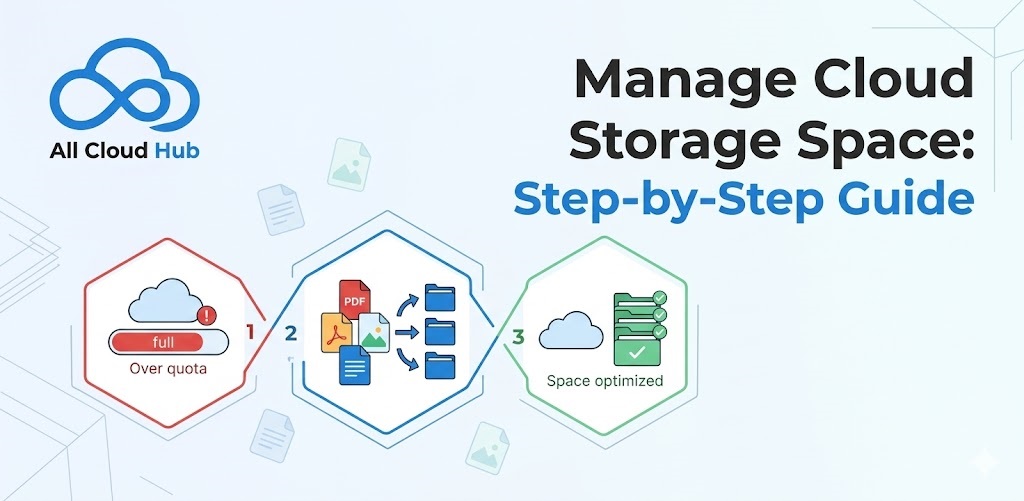
You’re staring at a “storage full” notification, but you haven’t saved anything new in weeks. Meanwhile, your files are scattered across Google Drive, Dropbox, OneDrive, and iCloud, each with its own storage limit and no way to see the full picture.
In 2025, 55% of people use three or more cloud services without a clear strategy for managing any of them. This guide walks you through checking your storage, freeing up space, and organizing files across all your cloud accounts without the usual download-and-reupload hassle.
What is cloud storage and why does it fill up
Cloud storage management, a $29.7 billion consumer industry, involves organizing, securing, and optimizing data stored on remote servers via third-party providers like Google, Microsoft, Apple, and Dropbox. In 2025, most people use at least two or three of these services, often without realizing how quickly space disappears.
Your storage fills up for a few predictable reasons. Automatic photo backups run quietly in the background every time you take a picture. Email attachments accumulate over months and years. Old device backups from phones you traded in years ago sit forgotten. Duplicate files, often created when sync conflicts occur, multiply without any notification.
Once you understand where your space is going, reclaiming it becomes much simpler.
How to check your cloud storage usage
Before deleting anything, you want to know exactly where you stand. Each major cloud provider offers a storage breakdown, though they place it in slightly different locations.
Google Drive
Navigate to drive.google.com/settings/storage to see your usage. One detail that surprises many users: Google shares this storage across Drive, Gmail, and Google Photos. A bloated inbox with years of attachments can eat into your Drive space even if you rarely save files there.
OneDrive
Go to onedrive.com, click Settings, then Storage. This page shows what counts toward your quota. Files shared with you that you’ve added to your own OneDrive also count against your limit.
Dropbox
Access your account at dropbox.com/account and click the Plan tab. You’ll see a breakdown of your storage usage, including any bonus space you’ve earned through referrals or promotions.
iCloud
On an iPhone, go to Settings > [Your Name] > iCloud. On a Mac, navigate to System Settings > Apple ID > iCloud. Both views display a color-coded bar that breaks down usage by category, making it easy to spot what’s consuming the most space.
| Provider | Where to check | What counts toward storage |
|---|---|---|
| Google Drive | drive.google.com/settings/storage | Drive files, Gmail, Google Photos |
| OneDrive | onedrive.com > Settings > Storage | Files, photos, Outlook.com attachments |
| Dropbox | dropbox.com/account > Plan | All files and folders in your Dropbox |
| iCloud | Settings > [Your Name] > iCloud | Photos, backups, iCloud Drive, app data |
How to free up cloud storage space
Now for the actual cleanup. The steps below are arranged from quickest wins to deeper cleanup, so you can stop whenever you’ve freed enough space.
1. Empty your trash and deleted items
When you delete files, they typically move to a trash folder where they continue counting against your quota for 30 days. Emptying the trash is the fastest way to reclaim space because you’ve already decided those files can go.
In Google Drive, click Trash in the left sidebar, then select “Empty trash.” In OneDrive, select Recycle bin, then “Empty recycle bin.” Dropbox and iCloud work the same way.
2. Review and delete unnecessary files
Sort your files by size to find the biggest space consumers first. Look for old project folders, outdated documents, and downloads you forgot about months ago.
Most cloud providers let you sort by “Storage used” or file size directly in their web interface. Start with the largest files and work your way down until you’ve freed enough space.
3. Clear cached and temporary data
Cached data consists of temporary files your apps create to load content faster. On mobile devices especially, offline sync files and app caches can consume gigabytes without any visible warning.
Check your iCloud or Google account settings for app-specific storage. Clearing caches for apps you rarely use offline often frees more space than you’d expect.
How to find and delete large files
Large files offer the biggest return on your cleanup effort. A single forgotten video file might free up more space than deleting fifty documents.
- Video files: Often the largest items in any cloud account, especially screen recordings and downloaded movies
- Design files: PSDs, Illustrator files, and RAW photos from cameras
- Old backups: ZIP archives, database exports, and disk images from previous computers
Google Drive
The Storage page at drive.google.com/settings/storage automatically sorts your files by size, largest first. This view is the fastest way to identify what’s consuming your space.
OneDrive
In the web interface, click the “Size” column header to sort files from largest to smallest. You can also filter by file type to narrow your search to just videos or images.
Dropbox
Use the file browser’s sort function to order by size. Dropbox also offers storage insights in your account settings that highlight your largest files and suggest items to remove.
How to find and remove duplicate files
Duplicate files are identical copies stored in different locations. They often appear when sync conflicts occur between devices, or when you upload the same file multiple times without realizing it.
Manually hunting for duplicates across even one cloud drive takes forever. Across multiple cloud accounts? Nearly impossible without help. Tools with cross-cloud search, like All Cloud Hub, can surface duplicates across all your connected accounts at once, showing you matching files regardless of which service stores them.
How to manage photos and videos in cloud storage
Photos and videos typically consume more cloud storage than everything else combined. A few minutes of cleanup here often frees more space than hours spent organizing documents.
Delete unwanted photos and videos
Review your camera roll backups for screenshots, blurry photos, and duplicate images. Most people find that 20-30% of their photo library consists of images they’d never look at again, including accidental screenshots and multiple shots of the same moment.
Compress large media files
Some services offer compression options that reduce file size while maintaining reasonable quality. Google Photos’ “Storage saver” setting, for example, compresses photos and videos to save space. The tradeoff is that you lose the original resolution, which matters if you plan to print large photos or edit videos professionally.
Move media to another cloud service
If one cloud account is full but another has available space, moving media between them solves the immediate problem. The traditional approach involves downloading files to your computer, then re-uploading to the other service. This works, though it takes time and uses your internet bandwidth twice.
How to reduce cloud backup sizes
Device backups often grow silently in the background. That old iPhone backup from three years ago? Still counting against your iCloud storage, even though you’ve upgraded phones twice since then.
Choose what to back up
Review your device’s backup settings and consider excluding apps with large local caches. Games, streaming apps, and social media apps often store gigabytes of data locally that you don’t actually want to back up, since you can re-download it anytime.
Delete old device backups
Backups from devices you no longer own frequently remain in your cloud storage indefinitely. In iCloud, go to Settings > [Your Name] > iCloud > Manage Storage > Backups to find and remove outdated backups. You might discover backups from phones you forgot you ever owned.
How to clear email attachments from cloud storage
Email attachments can consume surprising amounts of space. Gmail attachments count toward your Google Drive quota, and Outlook.com attachments count toward OneDrive. Years of work emails with PDF attachments add up quickly.
To find large attachments in Gmail, search for has:attachment larger:10M. This query surfaces emails with attachments over 10 megabytes. Review the results and delete emails you no longer reference. When you delete the email, the attachment disappears with it.
How to manage storage across multiple cloud accounts
Juggling Google Drive, Dropbox, OneDrive, and iCloud means juggling four different interfaces, four different storage limits, and no unified view of where your files actually live. You end up logging into each service separately just to figure out your total storage situation.
See all your cloud storage in one view
A unified dashboard lets you see storage usage across all your accounts without logging into each one separately. All Cloud Hub connects your cloud accounts and displays them in a single interface. Your files stay in their original locations, and you maintain full control over what gets accessed.
Search across all connected clouds
Searching one cloud drive at a time wastes time, especially when you can’t remember which service holds the file you want. Cross-cloud search lets you find files across all connected accounts with a single query, returning results from every service at once.
Tip: When you connect cloud accounts through All Cloud Hub, you sign in directly through each provider using OAuth 2.0. Your login credentials are never seen or stored by All Cloud Hub, and you can revoke access from your provider’s security settings anytime.
What to do when OneDrive is full
The “OneDrive is full” warning stops your sync and blocks new uploads. Here’s how to fix it quickly without losing important files.
1. Check your OneDrive storage breakdown
Go to your OneDrive settings to see what’s using your space. Pay attention to shared files you’ve added to your OneDrive, since they count against your quota even though someone else created them.
2. Delete or move large OneDrive files
Sort by size to identify the biggest files. Remove what you don’t want to keep, or consider moving older files to an external drive or another cloud service with available space.
3. Transfer files to another cloud service
If your OneDrive is full but your Google Drive has space, moving files between them solves the immediate problem. Cloud-to-cloud transfers move files directly between services without downloading to your computer first, which saves time and bandwidth.
How to move files between cloud services without downloading
A cloud-to-cloud transfer moves files directly between providers, say from Dropbox to Google Drive, without routing them through your local device. The files travel server-to-server instead of downloading to your computer and then uploading again.
- Faster transfers: Files move at data center speeds rather than your home internet speed
- No local storage required: Your computer doesn’t fill up with temporary downloads
- Less bandwidth usage: You’re not downloading and uploading the same files twice
All Cloud Hub offers drag-and-drop transfers between connected cloud accounts. Select files in one cloud, drop them in another, and the transfer happens directly between the services.
Advanced tips for cloud storage management
For ongoing control rather than one-time cleanup, a few practices help keep your storage organized over time.
Set up automatic folder sync across clouds
Folder sync keeps specific folders updated across multiple cloud drives automatically. When you add a file to a synced folder in Google Drive, it appears in the corresponding Dropbox folder without any manual copying. This works well for creating redundant backups or ensuring work files stay accessible across different services using one-way or two-way sync.
Use cloud-to-cloud transfers for large moves
When reorganizing storage or migrating between providers, direct cloud-to-cloud transfers save hours compared to the traditional download-and-upload method. For moving hundreds of megabytes, the time difference becomes significant.
Preview files without downloading to your device
Previewing files directly in your browser or management app avoids filling your local storage with temporary downloads. All Cloud Hub’s preview feature lets you view documents, images, and videos without downloading them first, which keeps your device’s storage free.
Manage all your cloud storage from one dashboard
With over 65% of people relying on cloud as their primary storage, managing multiple accounts leads to scattered files and wasted time switching between platforms. A single dashboard that connects all your accounts simplifies the entire process.
All Cloud Hub lets you search, move, sync, and manage files across Google Drive, Dropbox, OneDrive, and pCloud from one interface. Your files stay in their original locations. All Cloud Hub never stores, copies, or caches them on its servers. You sign in through each provider using OAuth 2.0, and you can monitor permissions or revoke access anytime from your provider’s security settings.
Try All Cloud Hub free and see all your cloud storage in one place.
FAQs about managing cloud storage
How do I access my cloud storage from any device?
Sign in to your cloud provider’s website or app on any device with internet access. Your files sync automatically when you log in with your account credentials, so you see the same files whether you’re on your phone, tablet, or computer.
Where are my cloud storage files physically stored?
Your files are stored on remote servers operated by your cloud provider in secure data centers around the world. You access them over the internet rather than from your local device’s hard drive.
Can I manage Google Drive, Dropbox, and OneDrive from one place?
Yes. Multi-cloud management tools like All Cloud Hub let you connect multiple cloud accounts and manage them from a single dashboard. Your files stay in their original locations, and you don’t have to move anything to see everything in one view.
Is it safe to permanently delete files from cloud storage?
Once you empty the trash, files are typically unrecoverable. Review items carefully before permanent deletion. Some providers offer a short grace period before files are truly gone, but don’t count on it.
How do I recover recently deleted files from cloud storage?
Check your cloud provider’s trash or recycle bin folder. Deleted files usually remain there for a limited time, often 30 days, before automatic permanent deletion. If you act quickly, recovery is usually straightforward.