
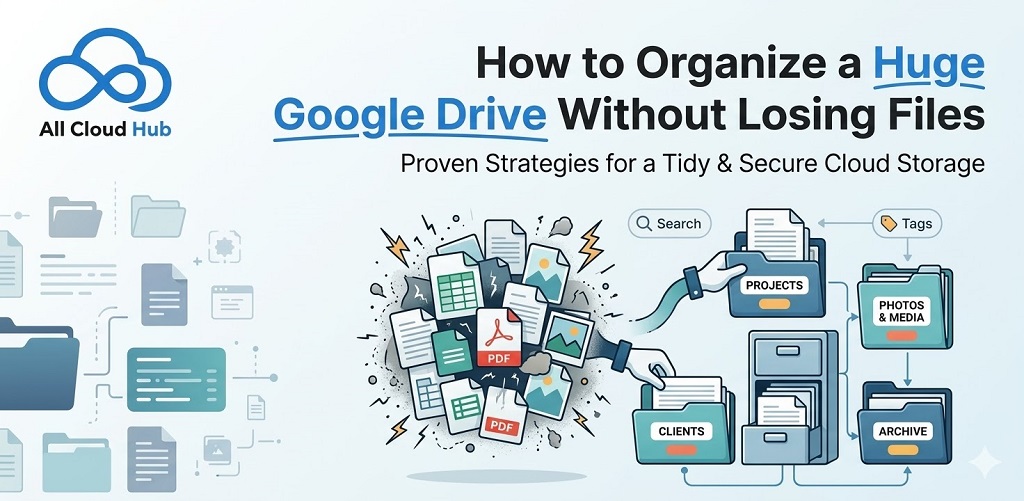
The files are there. They’ve always been there. But between the “Shared with me” clutter, the folders inside folders inside folders, and the seventeen versions of the same document all named slightly differently, actually locating the right file at the right moment takes longer than it should.
This guide is for anyone whose Google Drive has grown faster than their system for managing it. Whether you’re a freelancer juggling client projects or a small team sharing files across multiple people, the principles here are practical, easy to implement, and built to stay working as your Drive keeps growing.
The Real Problem With Most Google Drives
The typical Drive starts organized and gradually falls apart. A few folders become many. Files get shared without a home. Someone downloads something, renames it, and re-uploads it. Before long you have duplicates, orphaned files, and a search bar that’s doing more work than your folder structure.
The fix isn’t a one-time clean-up. It’s a structure that’s simple enough to maintain without thinking about it.
1. Stop Moving Shared Files, Start Using Shortcuts
The “Shared with me” section is where the Drive organization goes to die for most people. The instinct is to move shared files into your own folders, but this creates confusion about ownership and can break things for the person who shared them.
The better approach is shortcuts. When someone shares a file with you, right-click it and select “Add Shortcut to Drive.” This places a pointer to that file inside your own folder structure without duplicating it or touching the original.
You can also use Shift + Z to add a single file to multiple locations at once. A client budget spreadsheet can live in both your Finance folder and the relevant project folder simultaneously, with no extra storage used and no copies to keep in sync.
2. Keep Your Folder Structure Flat (The PARA Method)
Deep folder nesting is one of the most common causes of lost files. If something is five levels down, you will forget it exists. So will anyone else who needs to find it.
A structure that works at any scale is the PARA method, adapted for Google Drive:
- Projects: Active work with a deadline attached. These are the folders you’re in every week.
- Areas: Ongoing responsibilities that don’t have an end date. Marketing, finance, HR, client accounts.
- Resources: Reference material you might need later. Templates, research, brand assets.
- Archive: Completed projects and anything you’re keeping but no longer actively using.
The rule is three levels maximum inside any of these. If you find yourself going deeper, that’s a signal the folder belongs somewhere else or needs to be archived.
Color coding helps too. Red for active projects, grey for archives. It’s a small thing that makes scanning your Drive much faster.
3. Create an Inbox Folder and Actually Use It
One habit that prevents Drive chaos better than any folder structure is having a single place where everything lands first.
Create a folder called “00 Inbox” at the top of your Drive. Anything new goes there by default: downloads, uploads, files sent to you, work in progress. Once a week, spend ten minutes filing things out of it into their proper home.
The “00” prefix keeps it pinned at the top of your Drive alphabetically. The habit keeps clutter from spreading into folders where you actually need to find things.
4. Name Files So You Can Find Them Without Opening Them
Search only works well if your files are named in a way that matches how you’d look for them.
A naming convention that holds up over time follows this pattern: date, then type or category, then client or project name, then version.
So a client invoice from February 2026 becomes: 2026-02-03_INV_ClientName_ProjectX
A brand guidelines document becomes: INTERNAL_BrandGuidelines_v01
An old tax return becomes: ARCHIVE_2025_TaxReturns
The date format matters. Using YYYY-MM-DD means files sort chronologically by default. No more hunting for “the one from last March.”
Once your files are named consistently, Google Drive’s advanced search becomes genuinely useful. Rather than clicking through folders, you can filter directly from the search bar using operators:
| What you want | Search operator |
| Files over a certain size | larger:10mb |
| Files from a specific person | from:[email protected] |
| Files you’ve shared externally | to:[email protected] |
| Files modified recently | after:2026-01-01 |
| Exclude specific versions | ProjectName -final |
| Find a specific file type | type:pdf |
The last one is particularly useful for cleaning up. Searching ProjectName -v1 -v2 filters out old versions and surfaces only what’s current.
5. Search Scanned Files and Images Too
Most people don’t realise that Google Drive indexes the content inside images, scanned documents, and handwritten notes, not just filenames.
A photo of a whiteboard from a brainstorming session is searchable by the words written on it. A scanned receipt is findable by the vendor name. Handwritten meeting notes uploaded as images can be searched by their content.
If a scanned file isn’t showing up in search results, there’s a fix. Right-click the file, select “Open with Google Docs,” and let it load. This forces Drive to generate a searchable text layer over the document. After that, every word inside it becomes searchable even though the original file hasn’t changed.
This is particularly useful for anyone who keeps physical notes or receives scanned contracts and invoices.
6. Use Shared Drives for Anything That Belongs to a Team
If your team is storing files in individual “My Drive” accounts, you’re one person leaving the company away from losing access to things that matter.
Shared Drives solve this by making the drive itself the owner, not the individual. Files stay accessible regardless of who created them or whether they’re still at the company.
A consistent template across every Shared Drive reduces the time anyone spends figuring out where things are:
- 01 Agreements
- 02 Drafts
- 03 Resources
- 04 Final Deliverables
When every project folder looks the same, new team members can navigate immediately and nothing gets filed somewhere unpredictable.
7. Do a Quarterly Review, Not a Yearly Panic
A fifteen-minute review once a quarter prevents the annual “I need to sort out my Drive” situation that nobody enjoys.
Check who has access to files from finished projects and revoke external permissions that are no longer needed. Look for anything sitting in your Inbox folder or Downloads for more than thirty days and either file it properly or delete it. Search for filenames containing words like “final,” “v2,” or “copy” and clean up the versions that are no longer the actual final version. Move completed projects from active folders into Archive, which keeps your working view clean and your search results relevant.
8. When Your Files Span More Than Just Google Drive
Organising your Google Drive gets more complicated when it’s not the only place your files live.
A lot of people and teams are working across Google Drive and Dropbox, or Google Drive and OneDrive, at the same time. Different clients, different tools, different default platforms. The organisational system you build in one doesn’t automatically apply to the others, and searching across all of them separately defeats the purpose.
All Cloud Hub connects your Google Drive, OneDrive, Dropbox, and pCloud accounts into a single dashboard, so you can search across all of them at once, see recent files regardless of which cloud they’re in, and move files directly between clouds without downloading anything. If part of your organisational challenge is simply not knowing which account something ended up in, that’s the gap it fills.
The Short Version
If you want to organise a large Google Drive without losing files, here’s what actually works:
- Create an Inbox folder where everything lands first, and clear it weekly
- Use shortcuts instead of moving shared files
- Keep your folder structure to three levels maximum using the PARA method as your framework
- Name files with dates and clear labels so search works in your favour
- Use search operators for precision filtering, especially when cleaning up old versions
- Remember that scanned files and images are searchable too. If they’re not showing up, open them with Google Docs to force indexing
- Use Shared Drives for anything team-related so files don’t disappear when people leave
- Do a short quarterly review instead of letting things pile up
- If your files span multiple cloud accounts, All Cloud Hub gives you a single place to search and manage across all of them