March 2026 - Page 2 of 2 - All Cloud Hub

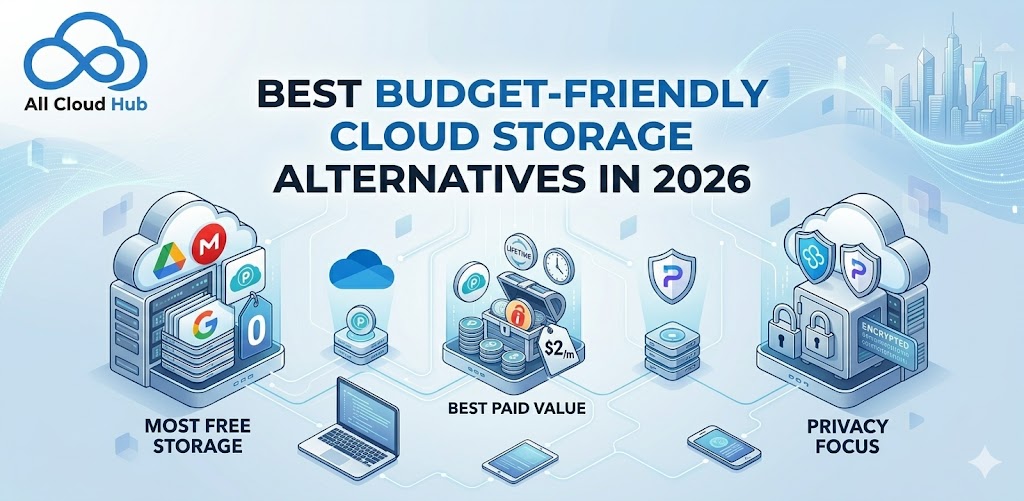
Best Budget-Friendly Cloud Storage Alternatives in 2026

Cloud storage makes it easy to back up files, share documents, and access data from anywhere. Services like Google Drive, iCloud, and OneDrive dominate the market, but their free tiers fill up quickly, often pushing users toward paid plans that cost more than they actually need.

Fortunately, several cloud storage providers now offer generous free tiers, lower pricing, and stronger privacy features without locking users into expensive subscriptions.

Many of these services deliver the same core features like file syncing, secure sharing, and cross-device access, while giving users more control over how their data is stored and protected.

This guide explores the best budget-friendly cloud storage alternatives available in 2026. You will learn which services offer the most free storage, which paid plans deliver the best value, and how privacy-focused providers differ from mainstream options. We will also look at practical ways to combine multiple providers so you can maximize storage without increasing costs.

Budget cloud storage options compared

Alternatives to cloud storage include local, self-hosted solutions like Network-Attached Storage (NAS) devices, external hard drives, or open-source platforms like Nextcloud.

All of these offer better privacy and no monthly fees.

However, if you want the convenience of accessing files from anywhere without maintaining hardware yourself, budget-friendly cloud storage services in 2026 deliver comparable features to premium options at a fraction of the cost.

Cloud storage means your files live on remote servers you access through the internet, rather than only on your local device. The tradeoff with local alternatives is that you handle backups, maintenance, and physical security yourself.

Cloud providers, on the other hand, manage redundancy automatically across multiple data centers.

ProviderFree TierPaid Starting PriceKey Strength
Google Drive15 GB~$2/monthCollaboration tools
pCloud10 GBLifetime option availableOne-time payment
MEGA20 GB~$5/monthEnd-to-end encryption
Sync.com5 GB~$8/monthZero-knowledge privacy
IDrive10 GB~$3/monthMulti-device backup

Best free cloud storage services

Free tiers work well for personal use, though they come with storage limits. When comparing options, pay attention to total storage amount, individual file size caps, and whether the service runs on all your devices.

Google Drive

Google Drive offers 15 GB free, shared across Gmail and Google Photos. If you already use Google Workspace apps like Docs or Sheets, everything integrates without extra steps. Your files save directly to Drive, and collaboration happens in real time.

pCloud

This Swiss-based service provides 10 GB free with desktop and mobile apps for Windows, Mac, Linux, iOS, and Android. What sets pCloud apart is its built-in media player that streams music and video directly from the cloud, so you don’t have to download files first.

MEGA

MEGA includes end-to-end encryption on its free tier. End-to-end encryption means the provider cannot read your files, even if compelled by legal request. You get 20 GB free, which is generous compared to most competitors.

Sync.com

Based in Canada, Sync.com offers zero-knowledge encryption at no cost. Zero-knowledge means the company never holds the keys to decrypt your data. Only you have access to your files, because the encryption keys remain entirely in your control.

Dropbox Basic

Dropbox Basic limits you to 2 GB free, which feels tight for most people. However, its sync reliability remains excellent. Files update consistently across every major platform, and the desktop app works quietly in the background.

Cheapest paid cloud storage plans

When free tiers feel cramped, paid plans open up more space. The pricing models vary quite a bit. Some services charge monthly, others annually, and a few offer lifetime purchases that eliminate recurring fees entirely.

IDrive

IDrive ranks among the cheapest options with plans starting around $3/month for 100 GB. Unlike most services, one account covers unlimited devices. If you have multiple computers and phones, you won’t pay extra to back them all up.

Sync.com Pro

Upgrading to Sync.com Pro keeps zero-knowledge encryption intact while expanding storage to 2 TB. At roughly $8/month, it balances privacy and affordability without forcing you to compromise on either.

pCloud Lifetime

pCloud’s lifetime plans let you pay once and use the storage forever. The upfront cost is higher, yet over three to five years, you typically save compared to monthly or annual subscriptions.

Icedrive

Icedrive offers a clean, modern interface with plans starting around $5/month. Client-side encryption, where files are encrypted on your device before upload, is available on premium tiers.

Best budget alternatives to Google Drive and Google One

You might consider switching from Google for privacy reasons — a survey found 43% of users concerned about data scanning by their cloud provider — pricing concerns, or simply to avoid keeping all your data with one company. Several cloud storage alternatives match Google’s functionality while offering different trade offs.

Proton Drive

From the team behind Proton Mail, Proton Drive applies end-to-end encryption to all files. Swiss privacy laws add another layer of protection. Proton cannot access your content even under legal pressure, because they don’t hold the decryption keys.

MEGA

MEGA provides more free storage than Google and encrypts everything by default. The web interface feels familiar if you’re used to Drive’s folder structure, so the learning curve stays minimal.

pCloud

pCloud’s optional Crypto folder adds an extra encryption layer for sensitive files. Combined with lifetime pricing, it appeals to users who want to reduce both costs and reliance on Google’s ecosystem.

Best budget alternatives to iCloud

Apple’s iCloud works smoothly within its ecosystem. Yet accessing files on Windows or Android devices gets awkward fast. Cross-platform cloud storage lets you reach your files regardless of which device you’re using at the moment.

Google Drive

Google Drive runs natively on iOS, Android, Windows, and Mac. For households with mixed devices, it offers more flexibility than iCloud’s Apple-centric approach. You can share files with anyone, not just other Apple users.

pCloud

pCloud’s automatic photo backup works similarly to iCloud Photos, syncing camera rolls across devices. Native apps exist for every major platform, including Linux. If you switch between Apple and non-Apple devices, pCloud handles the transition smoothly.

Sync.com

Sync.com provides the same privacy-focused approach across Apple and non-Apple devices. You won’t sacrifice security when switching between an iPhone and a Windows laptop.

Local and self-hosted alternatives to cloud storage

Some users prefer avoiding third-party servers entirely. Local solutions give you full control, though they require more hands-on management.

  • NAS devices (Synology, QNAP): A one-time hardware purchase that connects to your home network. You get massive storage capacity and no monthly fees, but setup requires some technical comfort.
  • External hard drives/SSDs: The simplest backup option. Files stay offline unless you physically connect the drive to your computer.
  • Self-hosted cloud (Nextcloud): Open-source software you run on your own hardware or a rented server. You get a Google Drive-like interface with complete control, though maintenance falls on you.
  • Peer-to-peer transfers: Tools that send files directly between devices without storing anything on third-party servers.

The trade off with local solutions is that you handle backups manually. Physical damage or theft can mean permanent data loss. Cloud backup services, by contrast, replicate your files across multiple data centers automatically.

How to choose the right cloud storage on a budget

Your ideal choice depends on what matters most to you. Here’s how to think through the decision without overcomplicating it.

Storage limits and pricing

Compare how much free storage each service offers and what paid tiers cost. If you dislike subscriptions, lifetime payment options from pCloud or Icedrive might appeal to you. Otherwise, annual plans typically cost less per month than paying monthly.

Security and privacy features

Standard encryption means the provider holds decryption keys and can technically access your files if required. Zero-knowledge or end-to-end encryption means only you hold the keys.

For sign-in security, look for OAuth 2.0 support. OAuth lets you authenticate without sharing your password with third-party apps. You sign in directly through your cloud provider, and the app receives requested accesses only.

Cross-platform compatibility

Check whether the service runs on all your devices: Windows, Mac, iOS, Android, and Linux. Some cloud storage locks you into one ecosystem, which creates friction if you switch devices later or share files with people using different platforms.

File sharing and collaboration tools

If you work with others, look for link sharing with password protection, granular permission controls, and real-time editing. Not every budget option includes collaboration features, so verify before committing.

Hidden costs and limitations of cheap cloud storage

Budget options come with tradeoffs worth knowing about upfront:

  • Bandwidth throttling: Free tiers often slow down upload and download speeds during peak times
  • File size limits: Some services cap individual files at 2 GB or less
  • Limited support: Cheap plans may not include priority help when something breaks
  • Feature paywalls: Version history, advanced sharing, or extra security may require upgrades
  • Sync restrictions: Some limit how many devices you can connect simultaneously

How to manage multiple cloud storage accounts

Combining free tiers from several providers maximizes storage without spending money — over 54% of users already rely on three or more cloud storage providers. The challenge is that your files end up scattered across different logins with no unified search. Finding a specific document means checking each service separately.

Multi-cloud management tools solve this by connecting your accounts into one dashboard. You can search across all your drives at once, move files between providers without downloading to your computer, and sync folders automatically.

All Cloud Hub connects your existing accounts via OAuth 2.0. Your files stay in your own drives, nothing gets copied to a third-party server, and you can revoke access anytime from your cloud provider’s settings.

Is free cloud data storage secure

Reputable free services use TLS encryption for data in transit and encrypt files at rest on their servers. With 54% of cloud data now classified as sensitive according to Thales Group’s 2025 Cloud Security Study, the key distinction lies in who holds the decryption keys.

  • Standard encryption (Google, Dropbox): The provider can technically access your files if required by law or internal policy.
  • Zero-knowledge encryption (Sync.com, MEGA, Proton Drive): The provider cannot access your files under any circumstances, because they never hold the keys.

Regardless of which service you choose, enable two-factor authentication and use a strong, unique password. Security features only work if you activate them.

Maximizing cloud storage without paying more

You can stretch free tiers further with a few practical steps:

  1. Audit existing files: Delete duplicates and outdated content cluttering your storage
  2. Compress large files: Reduce storage footprint before uploading, especially for archives and media
  3. Use multiple free accounts: Combine storage across providers strategically
  4. Connect accounts with a cloud manager: Search and organize files across all your drives from one place. All Cloud Hub lets you drag and drop between providers without re-uploading through your computer.
  5. Offload to local storage: Move rarely-accessed files to an external drive to free up cloud space

FAQs about cloud storage alternatives

Can I use multiple cloud storage services at the same time?

Yes, many users combine free tiers from Google Drive, pCloud, and MEGA to maximize storage without paying. Multi-cloud management tools help you access all accounts from one dashboard without switching between logins.

How do I transfer files between cloud providers without downloading?

Cloud-to-cloud transfer tools move files directly between services. The transfer happens server-to-server, so nothing routes through your computer and you avoid re-uploading large files.

What happens to my files if a free cloud storage service shuts down?

Reputable providers typically give advance notice and allow data export. Keeping backups across multiple services or local drives protects against unexpected shutdowns.

Do budget cloud storage options work for small teams?

Some budget services like Sync.com and pCloud offer affordable team plans with shared folders and permission controls. Features vary, so check whether the plan includes collaboration tools before signing up.

How do I search across all my cloud storage accounts at once?

Multi-cloud managers let you run a single search across Google Drive, Dropbox, OneDrive, and other connected accounts. Results from every service appear in one view, so you don’t have to check each drive separately.
How to Share Large Files Via Cloud Storage

Email bounces your 50MB file. You download from Dropbox, re-upload to Google Drive, then realize the client actually uses OneDrive. By the time you’ve finished shuffling files between services, you’ve lost twenty minutes and your patience.

Cloud file sharing simplifies this by letting you store files on remote servers and share them via link – no attachment limits, no platform mismatches. This guide covers how to share large files through cloud storage, move files between different cloud accounts, and keep your shared documents secure.

What is cloud file sharing

Cloud file sharing lets you store files on remote servers and share them with anyone via a link or direct permission. Instead of attaching a file to an email and hoping it doesn’t bounce, you upload it once to a service like Google Drive, Dropbox, or OneDrive, then send a link. The recipient clicks and downloads – no account required on their end, no file size drama on yours.

In 2026, the major platforms all work similarly at their core. Your files live on servers maintained by the provider, and you access them through a browser or app on any device. The same presentation you edited on your laptop this morning is already waiting on your phone. Real-time collaboration, link-based sharing, and cross-device sync have become standard features rather than premium extras.

Why use cloud storage services for large file sharing

No file size limits like email attachments

Email caps attachments at around 25MB for most providers, and corporate servers often cap attachments at 5–15MB. Try sending a video file, a batch of high-resolution photos, or a design project, and you’ll hit that wall fast. Cloud storage sidesteps the problem entirely. You upload the file to your cloud account and share a link. The recipient downloads directly from the server, and file size becomes a non-issue.

Access shared files from any device

Once a file lands in cloud storage, it syncs across every device connected to that account. You can start a document on your desktop, review it on your tablet during lunch, and share the final version from your phone on the train home. No USB drives, no emailing yourself attachments, no “which version is the latest” confusion.

Share without forcing recipients to switch platforms

Most cloud services generate public links that work for anyone. Your recipient doesn’t need a Google account to download a file from Google Drive, and they don’t need Dropbox installed to grab something you’ve shared there. They click the link, the file downloads, and that’s it.

Faster transfers with cloud-to-cloud moves

If you use multiple cloud services, moving files between them traditionally means downloading to your computer first, then re-uploading to the other service. That’s slow and tedious. Multi-cloud tools like All Cloud Hub let you transfer files directly between services, server to server, without routing anything through your device. The transfer happens faster, and you’re not babysitting a progress bar.

How to share large files via cloud storage

Step 1. Choose a cloud storage service or connect multiple accounts

Your choice often comes down to what you already use. If you’re deep in Google Workspace, Google Drive makes sense. Microsoft 365 users typically find OneDrive more convenient since it’s already integrated. If your files are scattered across several services, connecting them through a unified dashboard saves you from juggling multiple logins.

Step 2. Upload your large files or folders

Most cloud services support drag-and-drop uploads directly in your browser. You can also install desktop apps that automatically sync specific folders. Upload time depends on file size and your internet speed: a 2GB video file will take longer than a PDF, obviously, but the process itself is straightforward.

Step 3. Generate a shareable link or grant direct access

You have two main options here:

  • Shareable link: Anyone with the link can view or download. Quick for one-off shares when you don’t need to track who accessed what.
  • Direct access: You invite specific people by email, and they authenticate with their own account. Better for ongoing collaboration or sensitive files where you want a record of who has access.

Step 4. Set permissions and expiration dates

Before sharing, you can control what recipients can actually do with the file. View-only means they can look but not edit. Comment access lets them leave feedback. Edit access gives full collaboration rights. Many services also let you set expiration dates on links, which automatically revoke access after a certain time – useful for contracts, proposals, or anything with a limited shelf life.

Step 5. Send the link or invite recipients

Copy the link and send it however you normally communicate: email, Slack, text message, carrier pigeon with a QR code. If you used direct access, recipients get an email notification with a link to the shared file.

How to share files across multiple cloud accounts

Working across Google Drive, Dropbox, and OneDrive creates a familiar problem: you can’t remember which account holds which file. You end up opening three browser tabs, searching each service separately, and wasting time on what should be a simple task.

Multi-cloud management tools solve this by connecting all your accounts in one place.

Step 1. Connect your cloud accounts to a unified dashboard

Tools like All Cloud Hub let you link accounts via OAuth 2.0. This authentication protocol means you sign in directly with each cloud provider, Google, Microsoft, Dropbox, pCloud, and the management tool receives a token with limited permissions. Your password never touches the third-party tool.

Step 2. Search and locate files across all connected clouds

Instead of searching each service separately, you search once and see results from every connected account. When you’re tracking down a specific document and can’t remember where you saved it, this alone saves significant time.

Step 3. Move or copy files directly between cloud storage services

With a multi-cloud manager, you can drag a file from Dropbox and drop it into OneDrive, or migrate Google Drive to OneDrive entirely, without downloading anything to your computer. The transfer happens server-to-server, which is faster and doesn’t eat up your local bandwidth or storage.

Step 4. Share files without downloading or re-uploading

Once the file is in the right location or you’ve set up ongoing folder sync between accounts, you share it directly from that cloud account using the native sharing features. No intermediate steps, no duplicate files cluttering your downloads folder.

How to keep shared cloud documents secure

Security concerns are valid, especially when sharing business documents or personal files (for eg, 47% of cloud-stored data is classified as sensitive.) Modern cloud services offer strong protections but the key is actually using them.

Use OAuth 2.0 for account connections

When connecting third-party tools to your cloud accounts, look for OAuth 2.0 authentication. This protocol lets you grant limited access without sharing your password. You authenticate directly with Google, Microsoft, Dropbox or pCloud, and the third-party tool receives a token with only the permissions you approve. You can revoke that access anytime from your cloud provider’s security settings.

Enable password protection on shared links

Many cloud services let you add a password requirement to shared links. Even if someone intercepts the link, they can’t access the file without the password. It’s an extra step for your recipient, but worth it for sensitive files.

Set expiration dates for temporary access

For files that only need to be shared temporarily, set an expiration date on the link. After that date, the link stops working automatically. Particularly useful for contracts, proposals, or any document where access should be time-limited.

Monitor permissions and revoke access anytime

You can typically see who has access to your files and remove permissions instantly. This control matters when team members leave a project, when a client relationship ends, or when you realize you’ve shared something with the wrong person.

What to look for in file sharing cloud services

Not all cloud storage services work the same way. Here’s what to evaluate when choosing one or when deciding whether your current service still fits your workflow.

Cross-platform compatibility

Check whether the service works across Windows, Mac, iOS, Android, and web browsers. If you switch between devices frequently, gaps in compatibility create friction you’ll notice daily.

File size limits and storage capacity

Free tiers typically offer limited storage and may cap individual file uploads. Paid plans generally provide more space and higher per-file limits. Some services have no practical ceiling for cloud-native uploads on paid plans.

Security and encryption standards

Look for end-to-end encryption, often described as AES 256-bit. Some services offer zero-knowledge encryption, meaning even the provider can’t read your files. For sensitive business documents, this distinction matters.

Collaboration and permission controls

Real-time editing, granular permissions, and version history are essential for team use. If multiple people work on the same document, you want to avoid overwriting each other’s changes and be able to restore previous versions when needed.

Pricing and free tier availability

Most services offer a free tier with limited storage. Evaluate paid plans based on how much space you actually use and which features you can’t work without.

FeatureGoogle DriveDropboxOneDriveBoxpCloud
Free storage15GB2GB5GB10GBUp to 10GB
Real-time collaborationYesYesYesYesNo (limited collaboration features)
Best forGoogle Workspace usersFast syncing, large filesMicrosoft 365 usersEnterprise teamsPrivacy-focused users, lifetime plans, secure storage

Free vs paid cloud storage for file sharing

What free cloud storage services offer

Free tiers typically include a few gigabytes of storage, basic sharing features, and standard sync. However, you’ll encounter limitations:

  • Storage caps: Usually 2GB to 15GB depending on the provider
  • Feature restrictions: Password-protected links or advanced permissions often require a paid plan
  • Transfer speeds: Sometimes throttled compared to paid tiers

For personal use or light file sharing, free tiers often work fine. The limitations become noticeable when you’re working with larger files or collaborating with teams.

When to upgrade to a paid plan

Consider upgrading when you’re consistently running out of space, when transfer speeds feel sluggish, or when you need advanced security features like audit logs or extended version history. For teams, paid plans often include admin controls and priority support that make management easier.

Comparing popular cloud storage services

  • Google Drive: Strong integration with Google Workspace, generous 15GB free tier, real-time collaboration on Docs, Sheets, and Slides
  • Dropbox: Known for reliable syncing and fast large-file sharing, extensive third-party integrations
  • OneDrive: Deep integration with Windows and Microsoft 365, convenient for users already in that ecosystem
  • pCloud: Privacy-focused storage with optional lifetime plans, built-in media streaming, and client-side encryption available
  • Box: Enterprise-focused with robust permissions, workflows, and compliance features
  • MEGA: High security with zero-knowledge encryption by default, 20GB free tier

Manage cloud document sharing from one dashboard

If your files are scattered across multiple cloud services (the average organization now uses 3.4 providers), sharing becomes inefficient. You log into different accounts, search in multiple places, and manually move files between services when you need them somewhere else.

All Cloud Hub connects Google Drive, Dropbox, OneDrive, and pCloud into a single dashboard. You can search across all your clouds at once, drag and drop files between accounts, and share without downloading anything to your device. OAuth 2.0 connections mean your passwords are never stored, your files stay in your own cloud accounts, and you can revoke access anytime.

Get started with All Cloud Hub and manage all your cloud storage from one place.

FAQs about cloud file sharing

What is the maximum file size you can share via cloud storage?

File size limits vary by provider and plan. Free tiers typically cap individual uploads at a few gigabytes, while paid plans support much larger files. Some services have no practical limit for cloud-native uploads on higher-tier plans.

Can you share cloud files with someone who does not have an account?

Yes, most cloud storage services let you generate a public link that anyone can use to view or download without creating an account on that platform.

How long do shared cloud storage links stay active?

By default, links often remain active indefinitely. However, many services let you set custom expiration dates to automatically disable access after a specific time.

Is cloud file sharing safe for sensitive business documents?

Cloud sharing can be secure if you choose a provider with strong encryption like AES 256-bit, enable password protection on links, and regularly audit who has access to your files.

Can you share files stored across different cloud accounts from one place?

Yes, multi-cloud management tools let you connect accounts from different providers and share files across them without manually downloading and re-uploading between services.