cloud_dev, Author at All Cloud Hub - Page 3 of 5

Notifications & Preferences

All Cloud Hub keeps settings and preferences simple so you can focus on managing files.

Notifications

At present, All Cloud Hub does not expose detailed notification preferences in the Profile section.

System messages and status updates are shown directly in the interface when relevant, such as during file transfers or connection issues.

Note

Notification options may expand in the future as more features are added.

Preferences

Preferences related to file handling and connected services appear under the Settings area of the Profile page.

These settings control how All Cloud Hub behaves for your account.

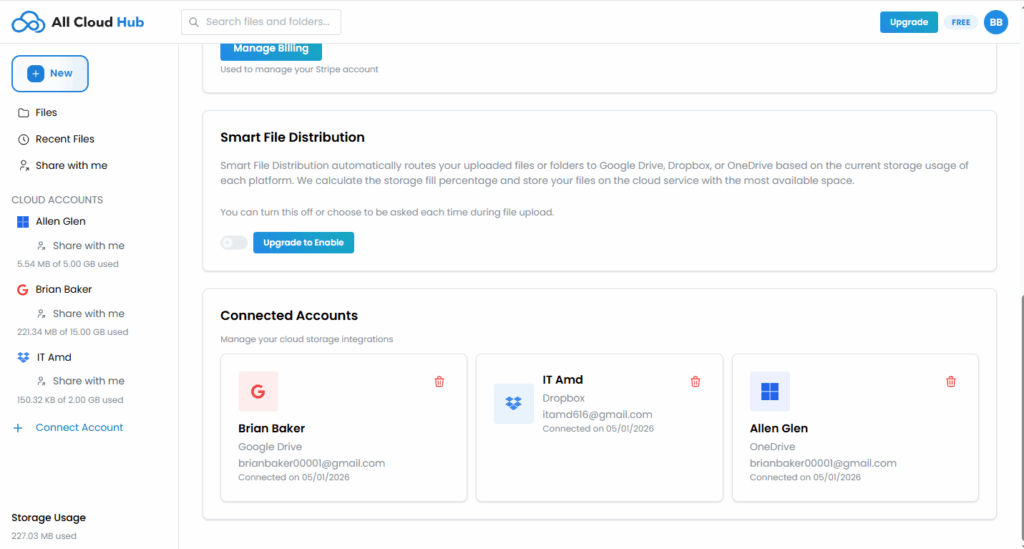
Smart File Distribution

The Smart File Distribution section describes an advanced feature that automatically routes uploaded files to connected cloud storage accounts based on available space.

If this feature is not enabled for your account, you will see an option to upgrade to access it.
Smart File Distribution section showing upgrade option

In Summary

Preferences and advanced features are managed from the Profile page, with clear indicators when a feature is not yet enabled.

Next: Deleting Your Account.
Subscription & Billing Basics

All Cloud Hub provides access to both free and paid features depending on your subscription status.

This article explains how subscription-related actions work without referencing specific prices.

Viewing Subscription Status

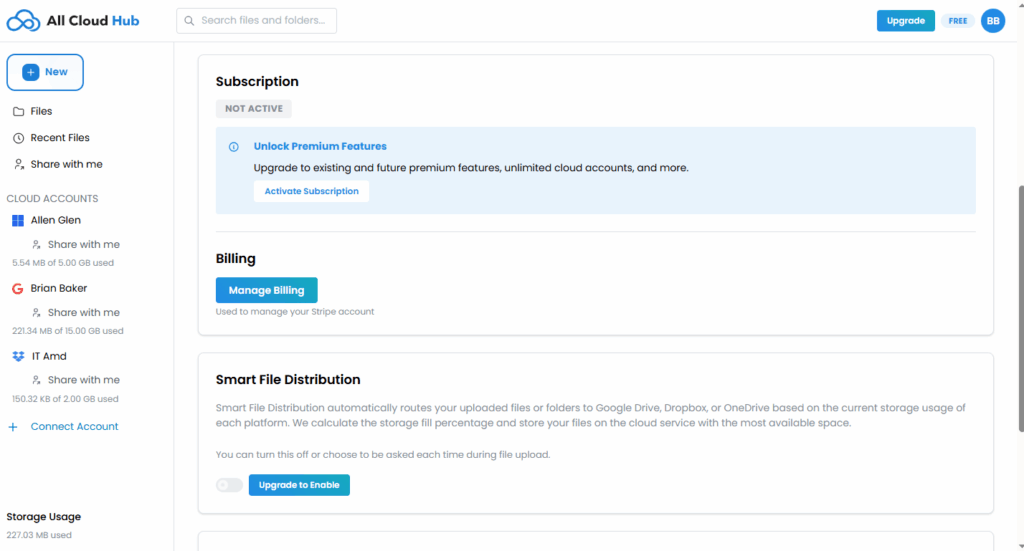
Your subscription status is visible in the Settings section of the Profile page.

If no subscription is active, this section indicates that premium features are not currently enabled.

Subscription section showing inactive status

Upgrading Your Plan

If you are on the Free plan, you will see an Upgrade option in the top-right corner of the dashboard.

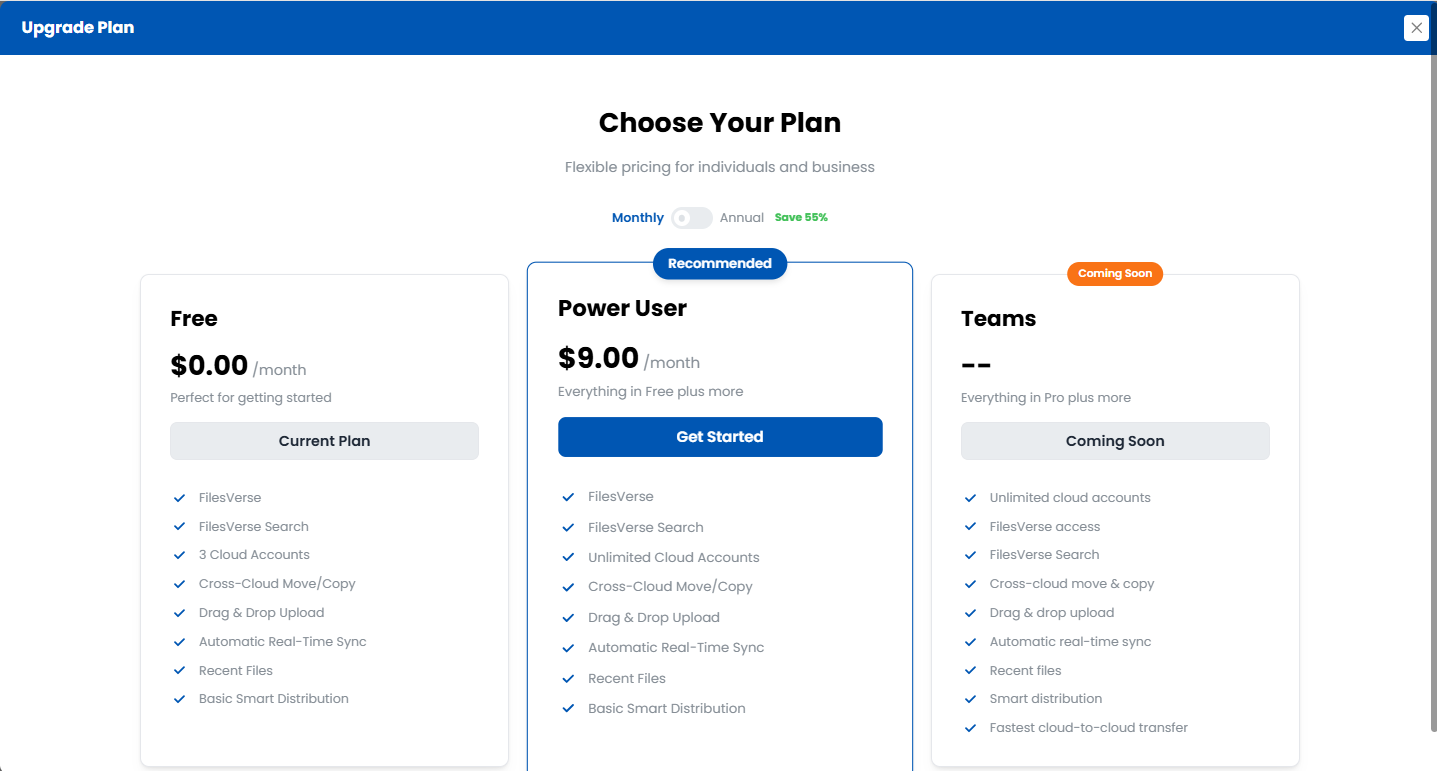
Clicking Upgrade opens the plan selection screen, where you can choose a different plan.

The help center does not list plan prices, as they may change over time.

Upgrade plan screen

Note

Upgrading unlocks additional capabilities such as connecting more cloud accounts and accessing premium features.

Managing Billing

In the Billing section, you will find a Manage Billing option.

This takes you to the billing management interface where you can manage your subscription details.

Billing is handled securely through the payment provider.

In Summary

Subscription and billing options are accessible from your Profile page and the Upgrade button in the dashboard header.

Next: Notifications and Preferences.

Managing Your All Cloud Hub Account

Your All Cloud Hub account settings help you manage your profile details, connected services, and subscription access from one place.

All account-related options are available from your profile menu.

Accessing Your Account Settings

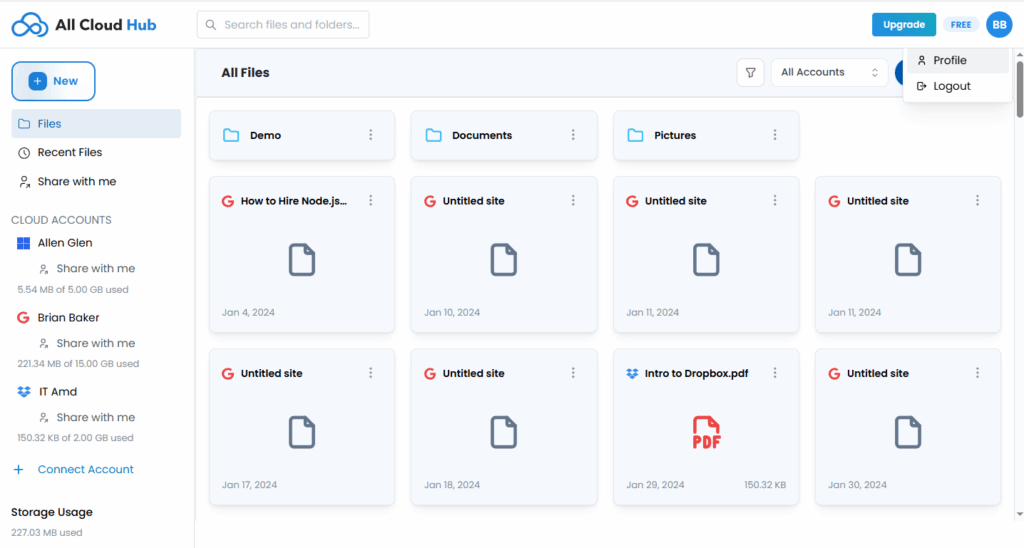
In the top-right corner of the dashboard, you will see an icon with your initials.

Clicking this icon opens a menu with the following options:

  • Profile
  • Logout

Select Profile to open your account and settings page.

Profile menu showing Profile and Logout options

Profile Details

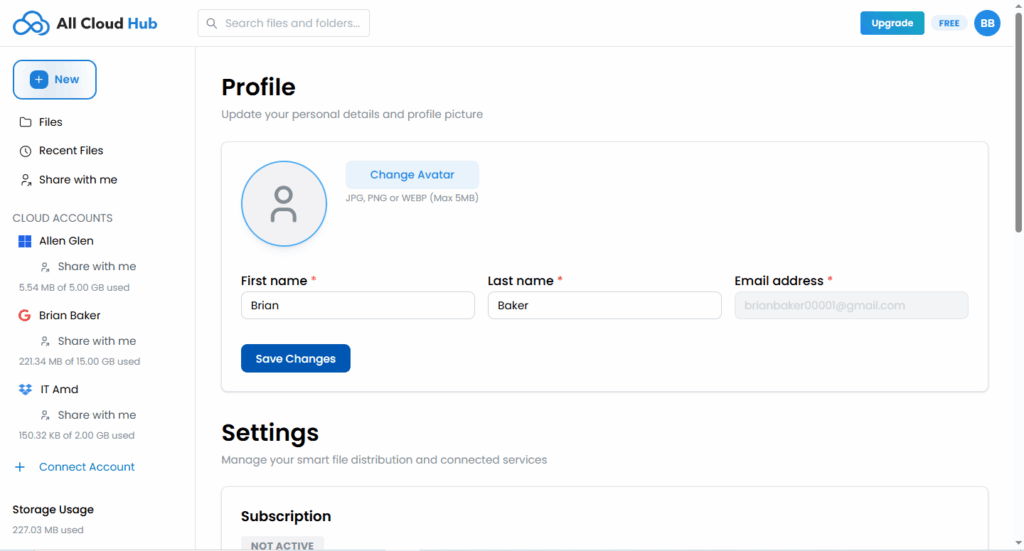
The Profile section allows you to manage your personal information.

From this page, you can:

  • Update your first name
  • Update your last name
  • View your email address
  • Change your profile avatar

After making changes, click Save Changes to apply them.

Profile details page with name fields and avatar option

Note

Your email address is shown for reference and cannot be edited from this page.

Logging Out

To sign out of All Cloud Hub:

  • Click your profile icon in the top-right corner
  • Select Logout

This logs you out of your current session safely.

In Summary

Your account profile lets you manage personal details and access account-level options from a single location.

Next: Subscription and Billing Basics.

Data Access, Logs & Privacy Controls

All Cloud Hub is designed to give you visibility into what happens to your files.

Nothing happens silently or without your awareness.

Data Access

All Cloud Hub accesses files only when you interact with them.

For example:

  • Opening a folder
  • Searching for a file
  • Transferring or syncing content

There is no background access or automated data processing.

Logs and Visibility

All Cloud Hub provides logs that show activity related to file actions and transfers.

Logs help you:

  • Understand what actions occurred
  • See whether operations completed successfully
  • Troubleshoot issues if something goes wrong

Logs do not contain file contents.

Privacy Controls

You control access at all times.

You can:

  • Disconnect any cloud account
  • Reconnect accounts when needed
  • Control how many accounts are connected based on your plan

Disconnecting an account immediately removes access and visibility inside All Cloud Hub.

Tip

If you ever feel unsure about access, disconnecting an account is the fastest way to stop it completely.

In Summary

All Cloud Hub gives you clear visibility and control over how your data is accessed and managed.

Files remain private, actions are user-initiated, and access can be revoked instantly.

Does All Cloud Hub Store My Files?

No. All Cloud Hub does not store file contents or create permanent copies of your data.

This is one of the most common questions users have, and the answer is simple.

Where Files Actually Live

All files shown in FilesVerse live in your connected cloud storage accounts.

All Cloud Hub does not upload files into its own storage or create permanent or hidden copies.

What All Cloud Hub Temporarily Handles

All Cloud Hub temporarily handles only the minimum file metadata required to display details and perform actions, such as:

  • File name
  • File path
  • File size

This metadata is used to show files correctly, track progress, and manage operations inside the dashboard.

Note

File contents are never stored or retained by All Cloud Hub.

Temporary Data

Any temporary metadata or session data used during active tasks is automatically cleared once the task is completed or the cloud account is disconnected.

In Summary

Your files always stay in your cloud storage accounts. All Cloud Hub does not store your files. It only temporarily handles limited metadata required for functionality, and removes it once tasks are completed.

Next: Data Access, Logs, and Privacy Controls.

OAuth Explained Simply

OAuth is the secure method used by cloud providers to allow third-party apps to access your account without sharing your password.

All Cloud Hub uses OAuth to connect to your cloud storage accounts safely.

What OAuth Means for You

When you connect a cloud account:

  • You are redirected to the cloud provider’s own login page
  • You sign in directly with that provider
  • You choose whether to grant access

Your password is never visible to or stored by All Cloud Hub.

What You Approve During OAuth

During the OAuth step, the cloud provider shows a list of permissions being requested.

These permissions allow All Cloud Hub to do things you explicitly choose to do, such as:

  • Viewing file lists and details
  • Organizing folders
  • Transferring files between clouds
  • Syncing folders

These permissions are used only to carry out actions you initiate, using temporary file metadata and secure connections.

Note

The wording on permission screens may differ between providers, but the purpose is the same.

Revoking OAuth Access

OAuth access can be revoked at any time.

When you disconnect a cloud account from All Cloud Hub, OAuth access is removed immediately and All Cloud Hub can no longer access that account.

In Summary

OAuth allows All Cloud Hub to work with your files securely without ever handling your password or taking ownership of your data. You stay in control of access at all times.

Next: Does All Cloud Hub Store My Files?

How All Cloud Hub Keeps Your Data Secure

All Cloud Hub is designed to help you work with your cloud files without taking control away from you.

Security is built around one simple principle: your files stay in your cloud storage accounts, and you stay in control of what happens to them.

Files Stay in Your Cloud Storage

All Cloud Hub does not move your files into its own system.

Your files remain stored in Google Drive, OneDrive, or Dropbox at all times. All Cloud Hub acts as a management layer that lets you view and work with files you already own, by securely handling only the minimum file information required for functionality.

Note

All Cloud Hub never becomes the owner of your files.

Secure Connections to Cloud Providers

All Cloud Hub connects to cloud storage services using secure authorization methods provided by the cloud platforms themselves.

This means:

  • You sign in directly with the cloud provider
  • Your password is never shared with All Cloud Hub
  • Access is granted only after you explicitly approve it

Direct Transfers and Actions

When you perform actions like transferring or syncing files, those actions happen through secure, browser-mediated connections with the cloud storage providers.

All Cloud Hub does not permanently store your files. Only the required file metadata and task state are handled temporarily to track progress and ensure reliability, and are removed once the action is completed.

User-Controlled Actions Only

All Cloud Hub performs file actions only when you initiate them.

There are:

  • No background file scans
  • No automated changes
  • No hidden activity on your files

Everything that happens is the result of a user action inside the dashboard. Temporary metadata used to carry out these actions exists only for the duration of the task and is not retained afterward.

All Cloud Hub is designed to minimize data handling at every step while still providing visibility, control, and reliability.

In Summary

All Cloud Hub keeps your data secure by leaving files where they belong, using secure authorization, and performing actions only when you request them.

Next: OAuth Explained Simply.

Avoiding Duplicate Files

Duplicate files are a common issue when working across multiple cloud storage accounts.

All Cloud Hub gives you tools to reduce duplication if used thoughtfully.

Choose Copy or Move Carefully

When transferring files:

  • Use Copy if you need the file in both locations
  • Use Move if the file should exist in only one cloud

Being intentional about this choice prevents unnecessary duplicates.

Warning

Copying files creates separate versions. Changes made to one copy do not affect the other unless the folder is synced.

Use Sync Instead of Repeated Copies

If files need to stay updated in more than one cloud, use folder sync instead of copying files repeatedly.

Sync ensures changes stay aligned and avoids manual duplication.

Watch for Similar File Names

When files from different clouds have the same name, it can be hard to tell them apart.

Use clear naming conventions or folder separation to reduce confusion.

In Summary

Avoiding duplicate files comes down to choosing the right action. Use copy intentionally, move when relocation is needed, and rely on sync when files must stay aligned.

Best Practices for Folder Structure

A clear folder structure makes syncing and organization more predictable.

These best practices help you avoid confusion when working across multiple cloud storage accounts.

Keep Synced Folders Purpose-Specific

Use sync for folders that serve a single purpose.

Examples:

  • Shared project folders
  • Active work folders
  • Team deliverables

Avoid syncing folders that contain unrelated or temporary files.

Use Clear Folder Names

Clear and descriptive folder names help you recognize synced content easily.

For example:

  • Client Name Shared
  • Project Assets
  • Final Deliverables

This reduces the risk of editing the wrong files.

Avoid Deeply Nested Structures

Very deep folder nesting can make syncing harder to track.

Keeping folder structures simple improves clarity and reduces mistakes when files are updated across clouds.

Tip

If you are unsure whether a folder should be synced, start with a smaller subfolder first.

In Summary

Well-structured folders make syncing safer and easier to manage across cloud storage accounts.

Next: Avoiding Duplicate Files.

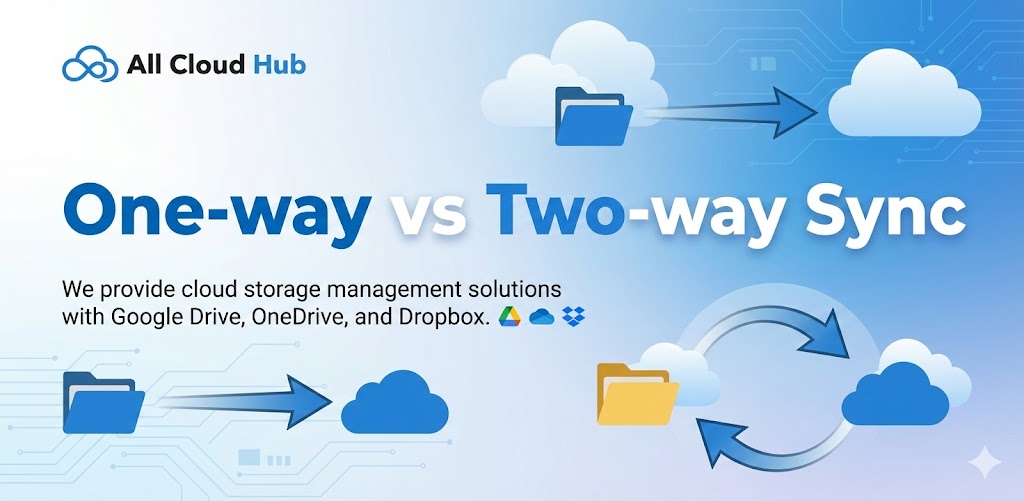
One-way vs Two-way Sync

Understanding the sync direction helps avoid unexpected changes.

All Cloud Hub currently supports two-way sync.

Two-Way Sync Explained

In two-way sync, changes made in either connected folder are reflected in the other.

For example:

  • A file added in Cloud A appears in Cloud B
  • A file updated in Cloud B updates in Cloud A
  • Renaming a file in either folder applies to both

This allows you to work from either cloud storage account without worrying about which one is the source.

Tip

Two-way sync works best when both folders are meant to stay identical.

One-Way Sync

One-way sync is not currently supported.

If one-way behavior is needed, it can be achieved manually using transfers instead of sync.

In Summary

All Cloud Hub uses two-way sync so folders remain aligned regardless of where changes are made.

Next: Best Practices for Folder Structure.

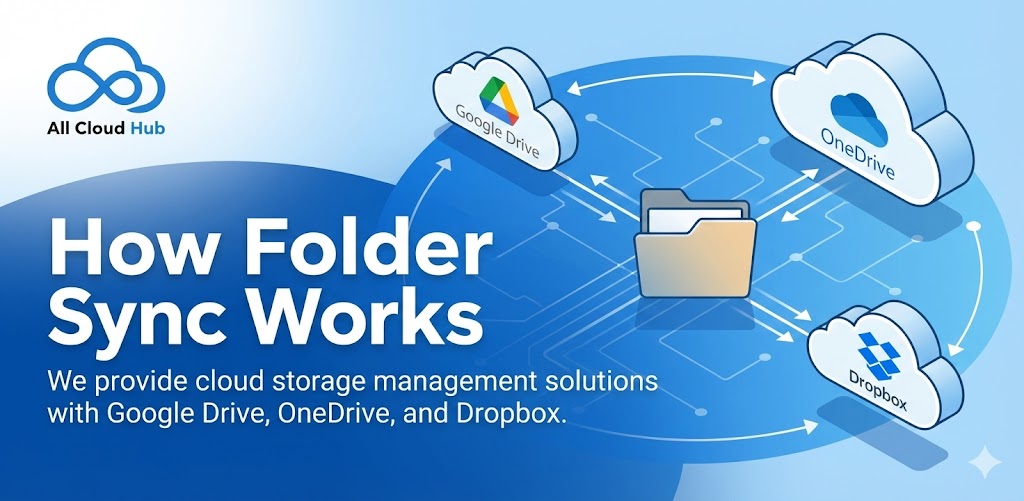
How Folder Sync Works

Folder sync in All Cloud Hub helps you keep folders aligned across multiple cloud storage accounts.

When sync is enabled, changes made in one folder are reflected in the connected folder on another cloud storage account. This allows you to work from either location while keeping both folders consistent.

What Sync Connects

Sync works at the folder level.

You select a folder from one cloud storage account and link it with a folder from another cloud storage account. Once linked, these folders are kept in sync based on the sync rules.

Files outside synced folders are not affected.

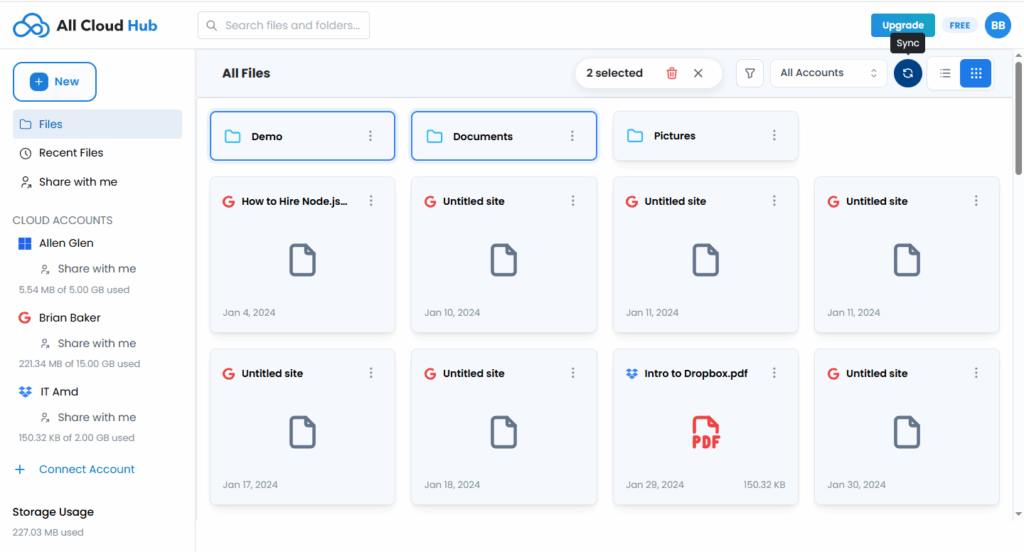
Sync setup showing two folders selected from different cloud accounts

How Changes Are Synced

When a change happens in a synced folder, All Cloud Hub detects the update and applies the same change to the connected folder.

This includes:

  • Adding new files
  • Renaming files or folders
  • Updating existing files

Sync helps ensure that both folders reflect the same structure and content.

Note

Sync only applies to the folders you explicitly connect. All other files and folders remain unchanged.

Where Sync Is Managed

Synced folders are managed from the Sync section in the dashboard.

From there, you can:

  • View active sync connections
  • Check sync status
  • Stop or remove sync when needed

In Summary

Folder sync in All Cloud Hub keeps selected folders aligned across cloud storage accounts so you do not need to manually update files in multiple places.

Next: One-Way vs Two-Way Sync.

Troubleshooting Failed Transfers

Most transfers complete without issues, but failures can occur due to external conditions.

This section explains common causes and what to do.

Common Reasons Transfers Fail

Transfers may fail if:

  • Network connection is interrupted
  • Cloud provider rate limits are reached
  • Browser session is closed mid-transfer
  • Access permissions are revoked

How Failures Are Shown

If a transfer fails:

  • An error is shown
  • The transfer status is updated in the Transfers or Logs section

Some files in a bulk transfer may succeed while others fail.

Retrying a Transfer

If a transfer fails, you can retry it after resolving the issue.

For example:

  • Reconnect the cloud account if access was revoked
  • Restart the transfer if the browser was closed

Warning

If you moved files and a transfer fails mid-way, some files may already exist in the destination cloud. Review both locations before retrying.

In Summary

Transfer failures are usually caused by network or provider limitations.

All Cloud Hub shows clear status information so you can understand what happened and take corrective action safely.