February 2026 - All Cloud Hub

Why Individuals or Small Businesses Need the Best Cloud Storage for Backup (Not File Sharing)

As data volumes grow, individuals and small businesses increasingly need cloud storage built for backup, not just file sharing. While tools like Google Drive, OneDrive, and Dropbox are excellent for collaboration and daily access, long-term data protection requires a different mindset and different capabilities.

This guide focuses on what actually matters when choosing the best cloud storage for backup, why file-sharing tools fall short for this purpose, and how relying on a single cloud can quietly increase risk.

Backup vs File Sharing: Why the Difference Matters

File-sharing tools are designed for speed, access, and collaboration. They work well when multiple people need to edit or view the same files. However, that same convenience becomes a liability when data protection is the goal.

Common issues with file-sharing tools used as “backup” include:

  • Files overwritten or deleted accidentally
  • Limited or short-term version history
  • No guarantee of long-term retention
  • Recovery workflows that assume the original file still exists

Backup cloud storage, on the other hand, is built for failure scenarios—hardware crashes, ransomware attacks, accidental deletion, or long-term data preservation. Its purpose isn’t daily access, but reliable recovery when something goes wrong.

What to Look for in the Best Cloud Storage for Backup
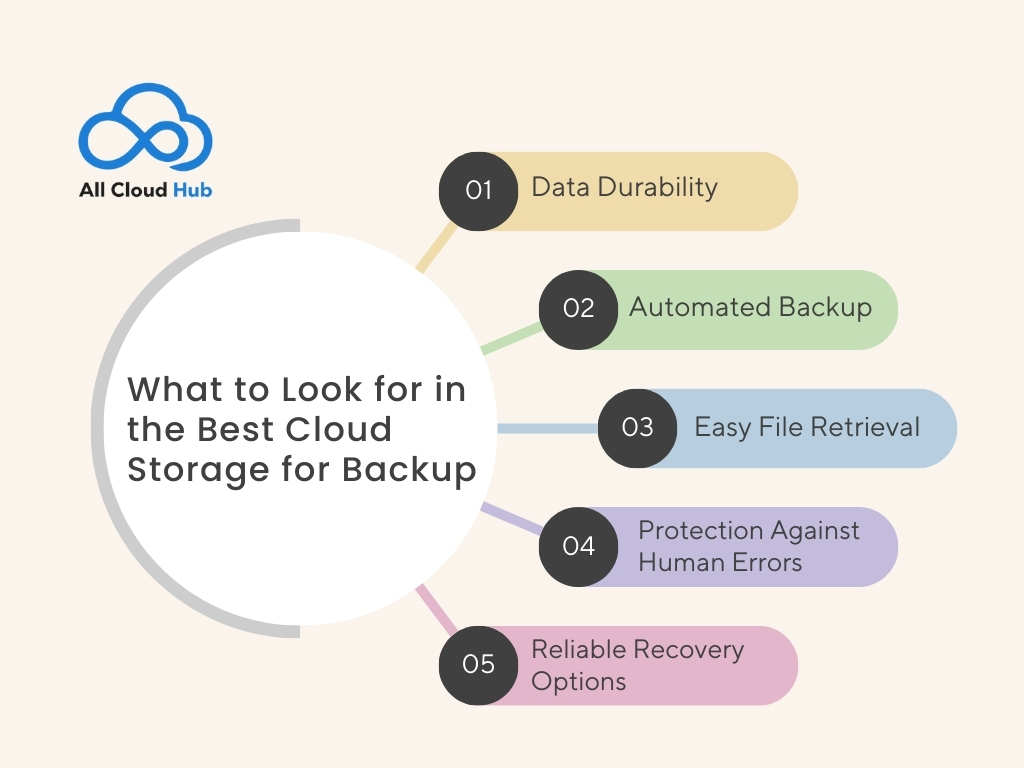
What to Look for in the Best Cloud Storage for Backup

The best cloud storage is designed keeping in mind to protect data for the long term. These solutions are primarily used during data-loss events such as hardware failure, cyber incidents, or accidental deletion. When evaluating cloud backup providers, features matter less than outcomes. A good backup solution should prioritize:  

  • Data Durability: This helps in ensuring that files remain intact in one place over extended periods.
  • Automated Backup: No more missed backups, and there will be no dependency on manual actions.
  • Easy File Retrieval: Cloud backup helps to retrieve specific files or earlier versions quickly when needed.
  • Protection Against Human Errors: Backup systems protect against accidentally deleting the files or overwriting them through version history and retention policies. 
  • Reliable Recovery Options: Cloud backup offers file restoration or supports the full recovery of the system. This maintains work continuity after hardware failures, unexpected data loss, or cybercrime.

Why Single Cloud Backups Can Be Risky for Businesses and Small Teams

File sharing isn’t backup, but a single cloud backup can also be risky.

It’s because relying on one cloud backup storage can leave the critical work data vulnerable to provider-specific failures, outages, and cyber attacks. Relying on a single backup location increases the risk of data loss if that provider experiences outages or security incidents.

This risk increases when individuals or teams need to preserve data indefinitely. However, using long term cloud storage system and backup strategies can increase resilience and reduce downtime. Businesses often implement redundant backup architectures to minimize downtime and enhance data availability. 

Streamlines IT operations and supports data modernization. It meets your business needs and increases performance and efficiency. Such a full-fledged cloud backup solution offers high availability and cost savings with the best security features.

The Case for a Multi-Cloud Backup Approach

A multi-cloud backup strategy reduces risk by distributing data across more than one provider instead of concentrating everything in a single environment.

Key benefits include:

  • Reduced dependency on any one cloud provider
  • Greater resilience during outages or access issues
  • Flexible long-term storage policies
  • Stronger recovery options when data loss occurs

Many users already rely on multiple platforms—Google Drive for documents, OneDrive for work files, Dropbox for media or client sharing. The challenge isn’t switching tools, but managing backups across them in a controlled way.

For a deeper explanation of why syncing tools are not designed for true backup and recovery, IBM’s overview of data backup principles provides useful, neutral context.

Managing Backups Across Multiple Clouds Without Complexity

Adopting a multi-cloud backup approach doesn’t mean changing where files are stored. It means having visibility and control across clouds.

This is where tools like All Cloud Hub fit naturally, not as another storage provider, but as a management layer that helps users:

Rather than replacing Google Drive, OneDrive, or Dropbox, All Cloud Hub supports a safer backup strategy by reducing blind spots and single-cloud dependency.
Already using Google Drive, OneDrive, or Dropbox

All Cloud Hub helps you manage and move backups across clouds without changing where your files live.

Explore multi-cloud backup management

Final Thoughts

A multi-cloud backup approach provides a stronger foundation for individuals and small businesses that need confidence their data will remain safe, accessible, and recoverable over time.

If managing backups across multiple clouds feels complex, you can explore how All Cloud Hub helps simplify multi-cloud backup visibility and control, without changing where your files already live.

FAQs

Is cloud file sharing the same as cloud backup?

No. Cloud file sharing is built for access and collaboration, not long-term data protection. Cloud backup focuses on retaining multiple versions of data and restoring files after accidental deletion, device failure, or cyber incidents.

What is the best cloud storage for backup for small businesses?

The best cloud storage for backup prioritizes data durability, automated backups, version retention, and fast recovery. Small businesses should focus on how easily data can be restored, not on collaboration or sharing features.

Why is relying on a single cloud backup risky?

A single cloud backup creates a single point of failure. Provider outages, account lockouts, or security incidents can all block access. Using a multi-cloud backup approach reduces this risk by distributing data across platforms.
Learn more about managing backups across providers with a multi-cloud storage manager.

How can I manage backups across multiple cloud providers easily?

You can manage multi-cloud backups by using a centralized tool that gives visibility across all cloud drives. Instead of replacing existing storage, this approach lets you organize and move backup data between providers using cloud-to-cloud transfers.
Cloud Storage Alternatives: When Google Drive or Dropbox Isn’t Enough

Google Drive and Dropbox are usually where cloud storage starts.

They are familiar, easy to use, and good enough in the early days. You upload files, share links, and everything feels neatly organised. For a while, it works exactly as expected.

Then your needs change.

Files grow. Accounts multiply. Storage fills up faster than you thought it would. And one day you find yourself searching for cloud storage alternatives, not because Google Drive or Dropbox failed, but because one tool is no longer enough.

If you have ever felt stuck switching between accounts, hunting for files, or wondering where something is actually stored, you are not alone. This is a very common point people reach as their digital life grows.

Signs You’ve Outgrown a Single Cloud Storage Account

Search engines and AI tools consistently surface these signals when users look for Google Drive alternatives or Dropbox alternatives:

1. Storage Limits Are Constantly in the Way

You’re forced to delete files, upgrade plans, or move data elsewhere just to keep working. Storage management becomes a recurring distraction instead of a one-time setup.

2. Multiple Accounts for Different Purposes

Personal files in one Drive, client data in another, backups somewhere else. Logging in and out becomes routine and risky.

3. Files Are Spread Across Too Many Tools

Documents live in Drive, media in Dropbox, archives on another service. Finding a single file turns into a search exercise.

Platforms like All Cloud Hub address this problem by focusing on visibility and access across cloud services, rather than forcing everything into one provider.

Why Juggling Multiple Storage Apps Becomes Stressful

Using more than one cloud platform is common but managing them separately creates hidden friction.

Fragmented Search Experience

Each platform has its own search logic. You may remember the file name but not the service it’s stored in.

Inconsistent Permissions and Access

Sharing rules differ between tools. Files may be accessible in one app but blocked in another, creating confusion for teams.

Duplicate Files and Version Conflicts

The same document exists in multiple places, slightly different each time. Over time, no one knows which version is correct.

This is where multi cloud storage strategies begin to outperform single-platform setups, especially when combined with aggregation tools.

How Files Quietly End Up Scattered Across Platforms

File sprawl rarely happens intentionally. It builds up gradually through everyday actions:

  • Uploading large files to Dropbox due to Drive limits
  • Backing up data to a separate service “just in case”
  • Sharing files externally because collaborators prefer different tools
  • Switching platforms without fully migrating old data

Over time, cloud storage becomes fragmented. Storage aggregation tools, like All Cloud Hub, are designed to reduce this complexity by bringing multiple cloud accounts into a single, manageable view.

One Dashboard Multiple Clouds

What to look for in Cloud Storage Alternatives

The best cloud storage alternatives do not always replace Google Drive or Dropbox. Often, they solve problems those tools were never designed to handle.

Multi cloud visibility becomes important once files live in more than one place. Being able to search and browse across platforms from a single interface removes a lot of daily friction.

Unified access control matters when permissions are spread across tools. Managing access without constantly switching dashboards saves time and reduces errors.

Flexibility is key. Good alternatives do not force you to migrate everything at once. You move files when it makes sense, not because a storage limit cornered you.

This separation between storage and management is where modern solutions stand out. You keep using the tools you already rely on, but without the chaos that comes from juggling them blindly.

Popular Cloud Storage Alternatives to Consider

1. Microsoft OneDrive

A common choice for organizations already using Microsoft 365.

Best for:

  • Office-centric workflows
  • Tight Microsoft ecosystem integration

Limitations:

  • Less flexible outside Microsoft tools
  • Similar storage cap challenges

2. Box

Focused on enterprise content management and compliance.

Best for:

  • Regulated industries
  • Structured document workflows

Limitations:

  • Higher pricing
  • Steeper learning curve

3. Multi-Cloud Storage & Aggregation Tools

Instead of switching providers, many users choose storage aggregation tools.

Why this works:

  • No need to abandon existing cloud accounts
  • Centralized file access
  • Reduced app switching

Platforms like All Cloud Hub fall into this category, helping users manage files across multiple clouds without adding another silo.

Final Thoughts

Searching for cloud storage alternatives is usually a sign of growth.

As files multiply and workflows evolve, single platform storage starts to feel restrictive. What once felt simple begins to feel limiting.

Whether you are evaluating Google Drive alternatives, Dropbox alternatives, or broader multi cloud strategies, the goal stays the same. Reduce friction. Improve access. Regain clarity.

Solutions like All Cloud Hub help bridge the gap by unifying cloud storage experiences, allowing people to work across platforms without losing track of where their files actually live.

Best Cloud Storage for Personal Use: Backup vs File Sharing Explained

Choosing the best cloud storage for personal use often seems simple at first. Many people rely on familiar platforms like Google Drive, Dropbox, OneDrive, or iCloud to store files, share documents, and access data across multiple devices.

In the early stages, everything works smoothly. There are only a few folders, a handful of documents, and maybe a collection of photos. Uploading files is easy, sharing a document takes only a few seconds, and accessing files from different devices feels incredibly convenient.

Because the experience is so seamless in the beginning, it’s easy to assume that all cloud storage services serve the same purpose. 

However, as personal data grows over time, the situation becomes more complicated. Storage limits begin to fill up, files end up spread across different platforms, and it becomes harder to understand what is actually protected and what is simply stored online.

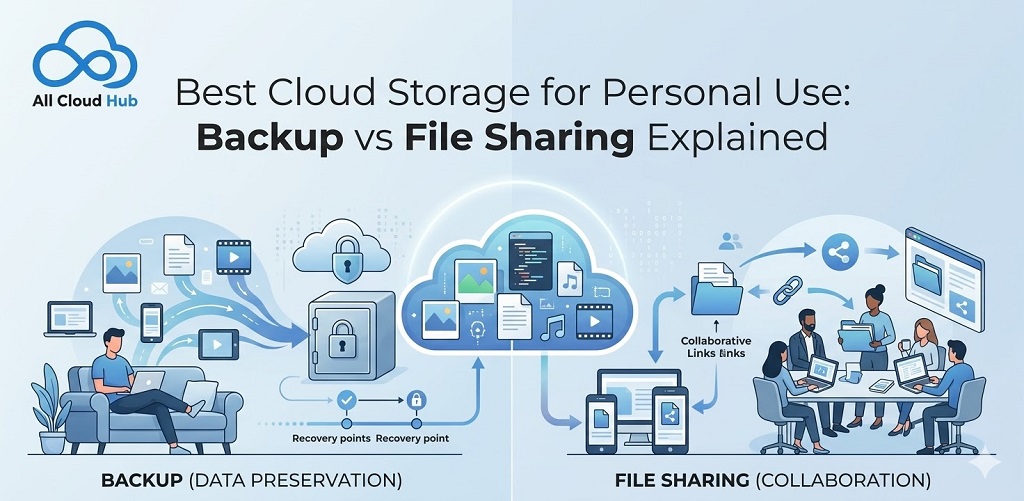
Much of this confusion comes from not understanding the difference between file sharing and cloud backup. While both involve storing files in the cloud, they are designed for very different purposes.

In this article, we will explain the difference between file sharing and cloud backup, explore what actually makes a reliable cloud storage setup, and look at practical ways to manage personal data more effectively as it continues to grow.

Why Cloud Backup Is Essential Today

Personal digital data has become more valuable than ever. It includes far more than casual photos or temporary documents. Financial records, identification files, work projects, creative content, and long-term personal archives are now stored digitally.

Because of this, losing access to important files can have serious consequences.

Many people assume that if a file is stored in the cloud, it is automatically protected. In reality, most cloud platforms focus primarily on syncing and sharing files rather than protecting them from permanent loss.

If a synced file is deleted, overwritten, or corrupted, those changes may be reflected across every connected device. Without a dedicated backup system, recovering the original version may not always be possible.

Cloud backup exists to solve exactly this problem. Backup systems maintain protected copies of files, store version history, and allow recovery even if files are accidentally deleted or damaged.

Over time, as personal data grows, the need to find a more reliable approach that gives an easy file access and data protection arises.

Understanding this distinction helps explain why managing personal cloud storage becomes more complex over time.

The Difference Between File Sharing and Cloud Backup

This is the difference most people miss, and it’s the root of nearly every personal cloud storage problem.

File sharing tools are designed for active, day-to-day use. They’re excellent for syncing folders across devices, collaborating with others, or quickly sending someone a link. But they operate on the assumption that you’re paying attention. 

Delete a file, and it disappears everywhere it was synced. 

Overwrite a document, and the previous version may be gone for good. 

Accidentally moving a folder to the wrong location, and recovering it isn’t always straightforward.

Let’s take an example: you are cleaning up your Google Drive, deleting what looks like duplicate files. A week later, you need one of those files, a scanned copy of an important document, and it’s gone. No version history or recovery option. 

That’s the gap file sharing tools leave open.

Cloud backup works from a completely different assumption. 

Files get accidentally deleted. Devices fail without warning. Data gets corrupted. 

Backup tools are built to quietly protect your files in the background, maintain version history, and make recovery possible when something goes wrong. 

You don’t have to manage it actively. It works whether you’re paying attention or not.

File sharing and cloud storage backup both serve important purposes, but they are not interchangeable. Relying on a file sharing tool alone, no matter how much storage it offers, it is not the same as having your data backed up.

What to Look for in the Best Cloud Storage for Personal Use

When evaluating cloud storage solutions, storage capacity alone should not be the deciding factor. A more useful approach is understanding what role each tool plays in your storage setup.

Some platforms are built for everyday file access and sharing, while others are designed to protect data in the background.

For example, services like Dropbox or Google Drive are excellent for collaboration. They allow users to sync folders across devices, edit documents with others, and quickly send files through shared links.

However, they are not primarily designed for long-term backup.

Backup-focused platforms such as Backblaze or IDrive work differently. Instead of helping you share files, they continuously back up your computer or folders so files can be restored even if they are accidentally deleted.

A common real-life setup might look like this:

A freelancer uses Dropbox to collaborate with clients and exchange design files. At the same time, they run Backblaze in the background to ensure every project file on their computer is automatically backed up.

Similarly, someone managing personal documents might store frequently used files in Google Drive for easy access while using IDrive to maintain backup copies of important folders like financial records or scanned identification documents.

When choosing cloud storage tools, it helps to consider a few practical questions:

  • Is the platform designed for sharing or for backup?
  • Can deleted files be recovered easily?
  • Does the service maintain version history?
  • Will the system remain manageable as more files accumulate?

For most individuals, the best solution is not relying on a single service but combining tools that handle access, protection, and organization.

What is All Cloud Hub and How it Fits in to Solve

All Cloud Hub is a cloud storage management platform that connects multiple cloud services into a single interface. Instead of replacing your existing storage providers, it allows you to link accounts such as Google Drive, Dropbox, or OneDrive and manage them from one centralized dashboard.

This becomes especially useful when files are distributed across different platforms.

For example, someone might keep work documents in Google Drive, personal files in Dropbox, and photos in OneDrive. Finding a specific file can mean opening multiple dashboards and searching through different folders.

With All Cloud Hub, these connected accounts can be accessed from one place. Users can search across platforms, organize folders, and move files between services without constantly switching between separate cloud interfaces.

Another common challenge to overcome is avoiding duplicate files. When the same document is shared or uploaded across different platforms, it can become difficult to identify the most recent version. A unified view of connected cloud accounts makes it easier to locate and organize those files.

Rather than acting as another storage provider, All Cloud Hub works as a management layer that brings existing cloud services together. For individuals using multiple platforms, it simplifies file visibility and helps turn scattered storage into a more organized system.

Stop Guessing Where Your Files Are

Ending Note – Storage vs. Security

As we discussed, cloud storage has become an essential part of managing personal digital life. From securing important documents to sharing photos and videos, these services help people keep their files accessible and secure across multiple devices.

However, the growing use of different cloud platforms often creates a new challenge of files getting scattered across different platforms and making file management more difficult.

Understanding the difference between backup-focused storage and file-sharing services is the first step toward choosing the best cloud storage for personal use.

For many users, the most practical approach is combining reliable cloud storage with tools that simplify organization. By bringing multiple services together into one interface, platforms like All Cloud Hub help transform a fragmented storage setup into a more structured and manageable system.

Cloud Backup vs Local Storage: Which One Is Safer in 2026?

In 2026, data loss isn’t rare—it’s expected. Laptops fail, hard drives age out, and devices go missing. The real question most people ask today isn’t if something will happen, but:

When it does, will my files still be there?

That’s where the debate around cloud backup vs local storage really begins.

Let’s look at how both options perform in real-life situations—and which one actually keeps your data safer.

What Happens When a Laptop Crashes or Disappears?

Imagine this scenario:
Your laptop won’t turn on after an update. Or worse—it’s stolen while traveling.

If your files live only on that device or an external hard drive, you’re instantly stuck. Recovery often means expensive repair attempts or total data loss.

This is one of the biggest local storage risks people face today. Hard drives don’t warn you before failing—they just stop working.

Cloud backup exists specifically to solve this problem.

Why Local Storage Alone Is No Longer Enough

Local storage feels safe. Your files sit right there on your laptop, desktop, or external hard drive—visible, physical, and seemingly under your control. For years, that sense of ownership made local storage the default choice for backups.

But in 2026, relying only on local storage is no longer practical—or safe.

Modern data usage has changed. We store larger files, work across multiple devices, and expect instant access anytime, anywhere. Local storage simply can’t keep up with these expectations, and its limitations are becoming harder to ignore.

Here are the most common issues with local storage today:

One device = one failure point

When all your data lives on a single device, everything depends on that device working perfectly. If a hard drive crashes, a laptop motherboard fails, or an external drive stops responding, your files can disappear instantly. There’s no built-in redundancy unless you manually create multiple copies—which most users don’t maintain consistently.

Manual backups that get delayed or forgotten

Local backups require discipline. You have to remember to plug in drives, copy files, and verify backups. In reality, backups are often postponed until “later.” Over time, weeks or months of new data may exist only in one place. When something goes wrong, users realize too late that their backups are outdated or incomplete.

Vulnerability to theft, fire, or water damage

Physical storage is exposed to physical risks. A stolen laptop, a house fire, flooding, or even power surges can wipe out years of data in seconds. Because local backups are often stored in the same location as the original device, a single incident can destroy both the primary files and their backups.

Hardware wear that happens silently over time

Hard drives and SSDs don’t fail overnight—they degrade gradually. Bad sectors, memory cell wear, and mechanical fatigue often go unnoticed until the device suddenly becomes unreadable. By the time warning signs appear, recovery can be expensive or impossible.

Even careful users fall into this trap. Files accumulate, storage fills up, backup routines slip, and everything quietly ends up depending on one device.

That’s why in 2026, more individuals and businesses are actively searching for cloud storage vs hard drive comparisons—not just for convenience, but for long-term data safety and resilience.

How Cloud Backup Works (Without the Tech Headache)

Modern cloud backup is designed to be invisible.

Once set up, your files automatically sync to secure cloud servers in the background. If your device fails, your data doesn’t.

With platforms like All Cloud Hub, users can manage cloud storage, backups, and file access from one centralized place—without dealing with complex tools or settings.

Key benefits include:

Automatic file backup

Cloud backup works continuously. Files are backed up in real time or at scheduled intervals without manual intervention. This eliminates the risk of outdated backups and ensures your most recent data is always protected.

Protection against device failure

Because files are stored off-site on secure servers, hardware failures don’t put your data at risk. Even if your device stops working entirely, you can restore your files on a new device within minutes.

Secure access from any location

Cloud backups aren’t tied to a physical device or location. Whether you’re working from home, traveling, or switching devices, your data is accessible whenever you need it—without carrying external drives or worrying about local storage limits.

No reliance on user memory or manual steps

The biggest advantage of cloud backup is consistency. There’s no need to remember to run backups, plug in drives, or manage storage manually. Once configured, the system works automatically, reducing human error—the most common cause of data loss.

This is why cloud backup safety has improved dramatically over the last few years.

Stop Gambling With Your Files

Cloud Storage vs Hard Drive: Safety Breakdown

When comparing cloud storage and hard drives, the real question isn’t convenience—it’s risk. What happens when something goes wrong? Looking at everyday failure scenarios makes the difference clear.

Local Storage (Laptop or External Drive)

  • Files exist in one physical location
    Data lives on a single device or drive, creating a single point of failure.
  • Failure = potential total loss
    Hardware crashes, corruption, or accidental damage can wipe out files instantly.
  • Backups depend on user discipline
    Manual backups are easy to delay or forget, often leaving data outdated or unprotected.
  • Recovery can be slow or impossible
    Data recovery is expensive, time-consuming, and not always successful.

Cloud Storage

  • Files stored across redundant systems
    Data is replicated across multiple secure servers, reducing the risk of loss.
  • Device failure doesn’t affect availability
    Even if a laptop or phone fails, files remain accessible.
  • Backups run automatically
    Continuous or scheduled backups ensure data stays protected without manual effort.
  • Easy recovery from anywhere
    Files can be restored quickly on any device with internet access.

So, is cloud storage safer than local storage?
From a risk perspective, yes—especially when cloud backups are properly managed through a unified platform like All Cloud Hub, which gives visibility and control across multiple cloud services instead of leaving data scattered and unmanaged.

Is Cloud Backup Actually Secure?

Security is a common concern when it comes to cloud backup, but most of these fears are outdated. Cloud platforms in 2026 follow far stricter security standards than many personal devices and local storage setups.

Today’s cloud backup solutions rely on multiple layers of protection, including:

Encrypted data transfers

Files are encrypted while moving between your device and the cloud, making intercepted data unreadable.

Secure access controls
Strong authentication and permission-based access help ensure only authorized users can view or manage files.

Redundant storage locations
Data is stored across multiple secure data centers, so hardware failures or outages don’t result in data loss.

Continuous monitoring
Cloud environments are monitored 24/7 to detect unusual activity, threats, or system failures early.

In many cases, cloud storage is actually more secure than personal devices, which often lack strong encryption, regular updates, or active monitoring.

The real difference lies in visibility and control. This is where All Cloud Hub stands out—by helping users manage multiple cloud services from a single interface, it reduces blind spots and gives better oversight of where data lives, how it’s protected, and who has access to it.

Best Practice in 2026: Combine Local + Cloud

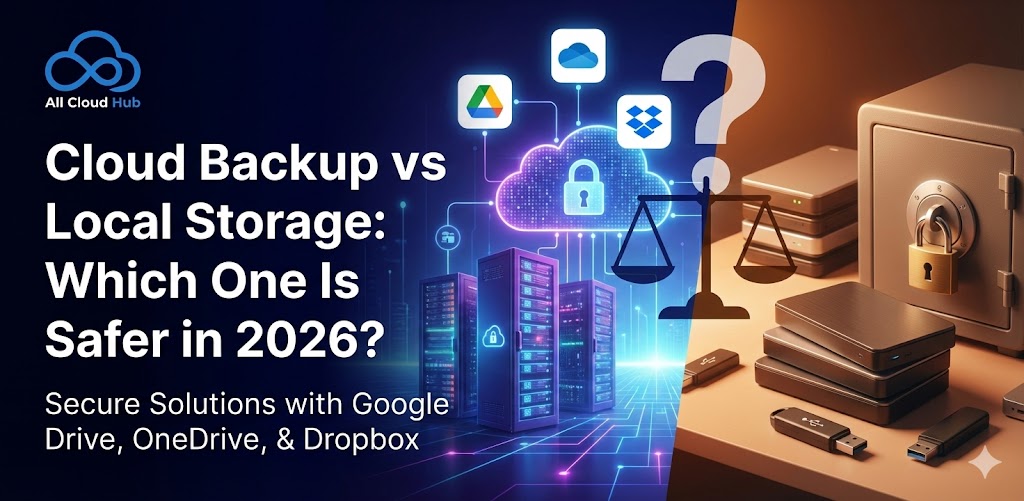
The smartest data backup strategies in 2026 don’t force you to choose between local storage and cloud backup—they combine both. Each serves a different purpose, and together they create a more resilient backup system.

Local storage works best for everyday tasks, such as:

  • Fast access
    Files stored locally open instantly without relying on an internet connection.
  • Offline work
    Ideal for situations where internet access is limited or unavailable.
  • Temporary files
    Drafts, working files, or short-term data that doesn’t need long-term retention.

Cloud backup is better suited for:

  • Long-term protection
    Files are stored securely off-site, protecting them from hardware failure or accidental loss.
  • Disaster recovery
    Even if a device is damaged, lost, or stolen, data can be restored quickly.
  • Cross-device access
    Files remain available across multiple devices and locations.

This hybrid approach balances speed, convenience, and security. It reduces risk without adding complexity—especially when cloud backups run automatically in the background. In 2026, combining local and cloud storage isn’t just a best practice; it’s the safest way to protect your data.

Final Verdict: Which One Is Safer?

When comparing cloud backup vs local storage, ask yourself one simple question:

How many things can go wrong before I lose everything?

With local storage, the answer is usually one.
With cloud backup, especially when managed through All Cloud Hub, multiple safeguards stand in the way.

In 2026, data safety isn’t about being technical. It’s about using systems that protect your files even when devices fail, mistakes happen, or life gets busy.

That’s why cloud backup has become the foundation—not the upgrade—of modern data protection.